
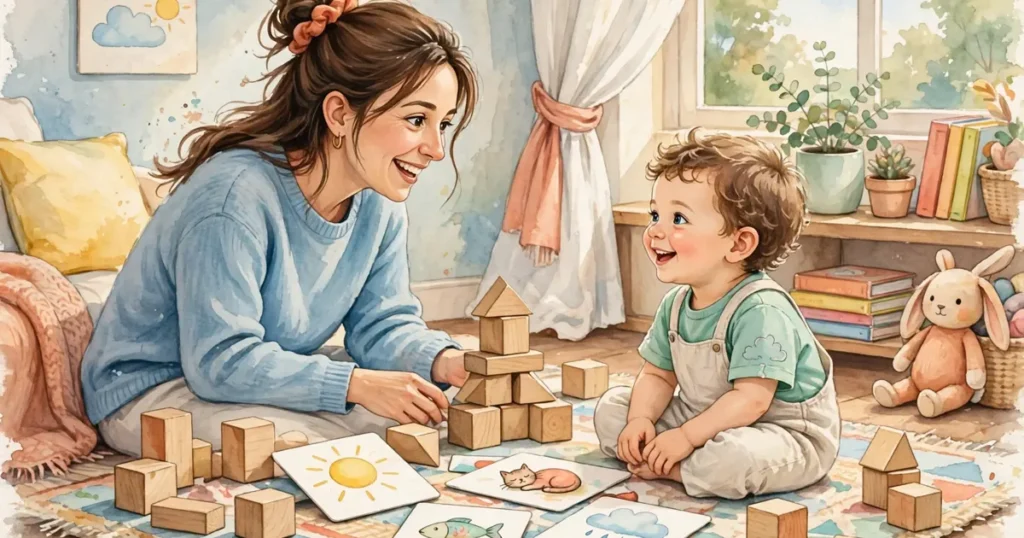
Child speech and language development is the journey a child takes from their very first cries, smiles and sounds to understanding language, talking in sentences, and joining in conversations, stories and learning. Speech means the sounds we produce when we talk, while language means the words, sentences and meanings we use to understand others and to share our own ideas. All children travel this road in the same broad order, but every child moves along it at their own pace.
This guide explains that journey in plain, simple language. It looks at the two halves of communication — understanding language and using language — and at how speech sounds, social skills and play grow alongside them. It also covers bilingual children, the role of hearing, things that can affect development, and the everyday things families can do to support talking at home. Finally, it explains the signs that suggest it is worth asking for professional advice. Wherever you are in the world, and whatever stage your child is at, this is a calm place to start.
Key Takeaways
- Communication begins long before first words, through eye contact, sounds, gestures and play.
- Understanding language (receptive language) and using language (expressive language) are two halves of one journey, and they do not develop in lockstep.
- Children follow a similar broad sequence of stages, but the pace varies a great deal from child to child. There is no single strict timetable.
- Everyday moments — chatting during routines, sharing books, singing songs and playing together — give children rich chances to learn language.
- Speaking two or more languages at home does not cause language difficulties.
- If you are worried about a child’s communication, you do not have to wait and watch. Asking for advice gives you information and options.
On this page
- Understanding and using language: two halves of communication
- How communication develops: a broad journey
- How speech sounds develop
- Social communication: more than words
- Play and communication
- Bilingual and multilingual children
- Hearing and communication
- What can affect speech and language development
- Supporting development at home: everyday strategies
- The school years: language for learning
- When to seek help
- Questions to ask a therapist
- Frequently asked questions
- Related guides
Understanding and using language: two halves of communication
When people talk about “language”, they often mean two different skills working together. Understanding both halves helps you see how your child is communicating now, and where they may need a little more support.
Understanding language (receptive language)
Receptive language is everything a child takes in and makes sense of: the words they hear, questions, instructions and stories. Long before children can say many words, they are busy understanding. They recognise familiar voices, respond to their name being called, and learn what everyday words mean.
Understanding is the foundation of talking. A child who does not yet understand a word cannot be expected to use it, so building understanding comes first — and it keeps growing throughout childhood, from simple everyday words to longer stories and more complicated ideas.
Using language (expressive language)
Expressive language is how a child sends messages to other people. It begins with crying, sounds, facial expressions and gestures. Over time it grows into words, then word combinations, then sentences, and eventually stories, explanations and conversations.
Expressive language is not only speech. Some children also use other ways to share their messages, such as signing with their hands, pointing to pictures on a communication board, or using a communication book. These are all genuine ways of communicating, and they sit alongside spoken language as it develops.
How the two halves fit together
Children usually understand more than they can say, and that gap is a normal part of learning. The two halves can also develop unevenly:
- One child may understand a great deal but say very little.
- Another may chatter happily yet struggle to follow longer instructions or stories.
- A third may be strong in both halves but hard to understand because of their speech sounds.
Watching both halves — what your child understands and what they can express — gives you the fuller picture of their communication.
Where speech fits in
Speech is different from language. Speech is the physical act of producing sounds clearly, using the breath, voice, tongue, lips and jaw. A child can have strong language, with plenty to say, but unclear speech. Another child may produce sounds clearly but have few words. This guide covers both language and speech, because both matter for being understood by others.
How communication develops: a broad journey
Communication grows step by step, and each step builds on the ones before it. The stages below are in broad order, but they overlap a great deal, and children move through them at very different speeds. Think of them as a map of the territory, not a timetable to measure against.
Before words: the first conversations
Babies communicate from the very beginning. A newborn’s cries, a baby’s smiles and cooing sounds, and the way a baby looks at faces are all early communication. In these early stages, children learn some big ideas:
- Sounds are for sharing. Babies babble — making strings of sounds — and enjoy “conversations” where an adult babbles back and the baby answers.
- People are interesting. Babies watch faces, enjoy voices, and begin to share attention with an adult. This sharing of attention — looking at the same thing together, sometimes called joint attention — is where many early words are learned, because the adult names what the baby is already looking at.
- Gestures say a lot. Reaching, waving, shaking the head and pointing are important steps. Pointing at something to share interest in it (“look at that!”) is a big step towards words.
- Understanding is quietly growing. Babies respond to familiar voices and routines, and begin to recognise everyday words in context, such as names of family members and objects they see every day.
First words and early talking
Somewhere along this stage, first meaningful words appear — usually words that matter in the child’s daily life, such as names of family members, favourite foods, animals, or social words like “hello” and “bye-bye”. At the same time:
- Understanding races ahead, and the child follows simple everyday instructions in familiar routines, especially with a gesture to help.
- Words are used for many jobs: naming things, asking for things, refusing, greeting people, and commenting on what is happening.
- New words arrive at an uneven pace — slowly at first for some children, then in a rush for others.
Some children take longer to move into this stage. A slower start does not, by itself, tell you how a child will do later. What matters is the direction of travel: whether communication keeps moving forward over time.
Putting words together
Next, children begin joining words — first two at a time, then building short sentences. Alongside this, another layer of language starts to grow: grammar. Grammar means the rules for ordering words and changing them so sentences make sense, such as putting words in the right order and using small words like “in”, “on” and “and”.
During this stage you may notice:
- Vocabulary (the words a child knows) growing quickly through play, books, outings and everyday talk.
- The child talking about things that are not in front of them, such as what happened earlier.
- Lots of questions, and plenty of opinions about what they want and do not want.
The preschool years
In the years before school, sentences become longer and more detailed. Children chat, tell you about their day in a simple order, and hold conversations that go back and forth several times. They understand stories and can answer questions about them.
This is also when children begin to play with the sounds inside words — enjoying rhymes, songs and silly sound games. This awareness of sounds is one of the building blocks that later supports early reading. Speech usually becomes clearer to people outside the family during this stage too, as more sounds are mastered.
Into the school years
Once children start school, language becomes a main tool for learning. Vocabulary keeps growing, including words for school subjects and more abstract ideas. Children learn to follow classroom talk, explain their thinking, tell organised stories, and adjust their talking for different listeners. Reading and writing build directly on these spoken language skills, and spoken language keeps developing right through childhood.
It is worth remembering that a child can be strong in one part of this journey and still be finding another part hard. A child may have a wide vocabulary but find conversations tricky, or tell wonderful stories but have unclear speech sounds. Each area deserves its own attention.
How speech sounds develop
Learning to say all the sounds of a language takes time. Speech sounds are learned gradually, easier sounds first and harder sounds later, and children need many chances to hear sounds and practise them in words.
Young children simplify words in predictable ways while they are learning. For example, they may:
- Leave off the end of a word.
- Swap a harder sound for an easier one.
- Shorten long words to the parts they can manage.
These simplifications are a normal part of learning to talk, and they fade as the child’s speech system matures. Clarity also grows with listening: children fine-tune their sounds by hearing how words sound when other people say them. This is one reason familiar adults often understand a young child long before visitors can — the family has learned the child’s personal version of each word.
Every language has its own set of sounds, so children learn the sound system of whatever language or languages are spoken around them. Children learning two languages are learning two sound systems, which is a lot of learning happening at once.
If people who know a child well regularly cannot understand what the child is saying, or if the child’s clarity does not seem to be improving over time, that is worth discussing with a professional. You can read more about this in the when to seek help section below.
Social communication: more than words
Social communication means the social side of language — how we use words, sounds and body language with other people. It includes:
- Looking at and listening to the person talking.
- Starting a conversation, and joining one that is already going.
- Taking turns — talking, then listening, then talking again.
- Choosing words that suit the listener, such as speaking differently to a friend, a teacher or a younger child.
- Understanding facial expressions, tone of voice and body language.
- Following stories and jokes, and noticing when a listener has not understood.
These skills grow out of everyday interactions from babyhood onwards: back-and-forth sound games with a baby, simple turn-taking games with a toddler, and conversations around the table as children grow. Attention and listening are part of this too — a child who can look, listen and wait for a turn has the foundations that conversation is built on.
Social communication can grow at a different speed from words and sentences. Some children have plenty of vocabulary yet find the to-and-fro of conversation hard. Others are eager communicators socially long before they have many words. Both halves of communication — the language itself and how it is used with people — matter for friendships, learning and confidence.
Play and communication
Play is not a break from learning — for young children, play is how learning happens. Through play, children practise words, try out ideas, take turns and build the imagination that stories and conversations depend on.
Play itself develops in a broad sequence:
- Exploring play: babies and toddlers mouth, shake, bang and drop toys, learning what things are and what they do.
- Everyday play: children act out familiar actions, like pushing a toy car, stirring an empty pot or feeding a doll.
- Pretend play: imagination grows — a box becomes a boat, a block becomes a phone, and children act out little scenes from daily life.
- Playing with others: children move from playing alongside others to playing together, sharing ideas, negotiating roles and solving small problems as a team.
- Games with rules: simple games with turns and rules build listening, waiting and coping with winning and losing.
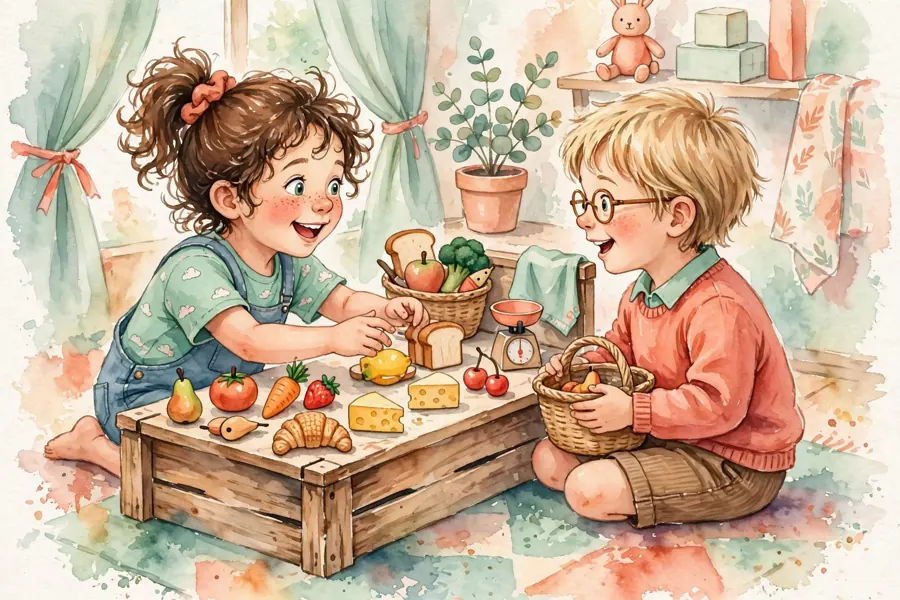
Adults support both play and language by joining in at the child’s level, following the child’s ideas rather than directing the game, and chatting about what is happening as they play. When a child pretends to cook, for example, an adult who joins the game, asks for a pretend cup of tea and talks about the “cooking” is giving the child words, turns and story ideas all at once.
Bilingual and multilingual children
In many homes around the world, children grow up hearing and learning two or more languages. This is a common and valuable way to grow up, and it brings real strengths, including the ability to connect with wider family and community.
A few important points for families:
- Bilingualism does not cause speech or language difficulties. Learning two languages does not confuse children or hold back their talking.
- Mixing languages is normal. A bilingual child may use words from both languages in one sentence. This is a natural part of learning two languages, not a sign of a problem.
- Vocabulary is shared across languages. A child may know “water” in one language and the word for “dog” in another. What matters is the total understanding and communication across all their languages.
- Difficulties show in every language. If a child does have a language difficulty, it appears in all the languages they speak — not just one. Struggling in one language only is more often about still learning that language.
- Use the language you speak best. Children learn most from rich, natural talk. The language you are most comfortable and fluent in is the best one to chat, read and sing in with your child. You do not need to switch to a language you speak less well.
If you are worried about a bilingual child’s communication, an assessment that takes all of the child’s languages into account gives the fairest picture. Telling the professional which languages are used at home, and by whom, is very helpful information.
Hearing and communication
Children learn the sounds and words of language by hearing them, clearly and often. Hearing is therefore closely linked to speech and language development — a child who is not hearing speech clearly may learn sounds and words more slowly, or say sounds less clearly.
A young child’s hearing can vary. Temporary dips in hearing are common alongside colds and ear infections. Sometimes fluid builds up behind the eardrum and stays for a while, which can dull sounds in a similar way to listening with fingers in your ears. For many children this clears on its own, but while it lasts it can affect how clearly they hear everyday speech.
Possible signs that hearing is worth checking include a child who often does not respond when called from another room, frequently asks for things to be repeated, watches faces very closely when listening, or seems to hear some days better than others. None of these signs proves there is a hearing difficulty — but if you notice them often, arranging a hearing check through your doctor or local health service is a sensible step.
If a hearing difficulty is ongoing, support for the child’s communication matters alongside any hearing care, and professionals can advise on both together.
What can affect speech and language development
There is no single reason why children’s communication develops at different rates, and often there is no clear cause at all. Some of the things that can play a part include:
- Hearing difficulties, as described above, which can make speech sounds and words harder to learn.
- Developmental language disorder (DLD). Some children have a lasting difficulty learning language that is not explained by another condition. Professionals may call this developmental language disorder. These children may need ongoing support with understanding, talking, or both.
- Wider developmental differences. For some children, communication develops differently as part of their overall pattern of development — for example, autistic children, and children with learning disabilities, may follow a different communication path and benefit from support that is shaped around them.
- Family patterns. Speech and language difficulties can run in families, so a parent or sibling who found talking hard as a child can be part of the picture.
- Early health and experiences. Babies who are born early, or who have been unwell, may develop communication at a different pace and may have extra follow-up as they grow.
- Opportunities to interact. Children learn language from responsive interaction — talking, playing, reading and being listened to. Hard or busy periods happen in every family, and small moments of talk still count. Support and ideas are available to every family, without blame.
Whatever the reason, the starting point is the same: understanding how a child communicates now, and building from their strengths. An assessment can help explore what may be contributing and what kind of support would suit the child.
Supporting development at home: everyday strategies
You do not need special equipment, lessons or extra money to support your child’s communication. Children learn language from the people around them during ordinary days, and you are already the most important of those people. The ideas below are simple, and they are used by families everywhere. Choose the ones that fit your routines, your language and your culture.
| Area of development | What it involves | Everyday ways to support it |
|---|---|---|
| Understanding language | Making sense of words, instructions and stories | Talk about what you are doing; keep sentences short and clear; give one instruction at a time |
| Using language | Sharing messages with sounds, gestures, words and sentences | Offer choices; wait for a response; respond warmly to every attempt to communicate |
| Speech sounds | Producing the sounds of words clearly | Say words clearly and naturally; repeat words back in their correct form, without asking the child to copy |
| Social communication | Turn-taking, listening and joining in conversations | Play turn-taking games; chat about feelings and other people’s ideas |
| Play and imagination | Exploring, pretending and creating stories | Join in your child’s play; follow their ideas; add a word or two as you play |
Talk during everyday routines
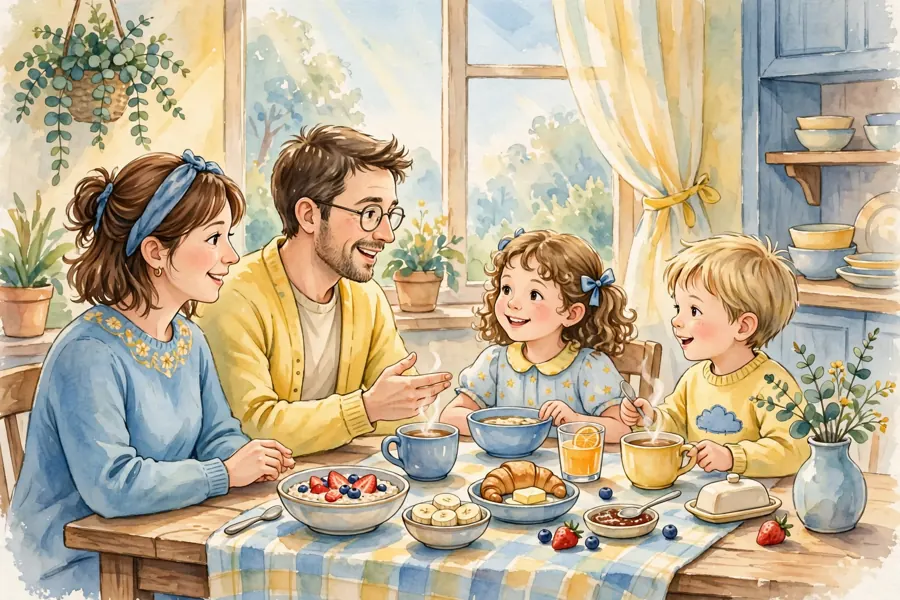
Meals, bath time, getting dressed, shopping and tidying up are full of language. Name the things you are using, describe what you are doing, and talk about what happens next. Words learned inside real routines are remembered because the child can see and do what the words mean.
Get face to face
Come down to your child’s level when you talk and play, so they can see your face and mouth, and you can see theirs. Eye contact, smiles and expressions are all part of the message.
Follow your child’s lead
Talk about whatever has caught your child’s interest — the bug on the path, the picture in the book, the noise outside. Children learn words fastest for the things they are already paying attention to.
Wait and give time
After you speak, pause and wait before speaking again. Children need time to take in what you said, find their own words and get them out. Waiting quietly, while looking interested, invites a response far better than quickly filling the silence or repeating the question.
Offer choices
Holding up two options — “the apple or the banana?” — gives a child a reason to communicate, a chance to point or use a word, and a model of the words they need, all at once.
Expand what your child says
Repeat your child’s message back and add a little. If your child says “car”, you might say “yes, a big red car”. If they say “dog run”, you might say “the dog is running fast”. This shows the next step without correcting or putting the child on the spot.
Comment more than you question
Questions have their place, but a stream of “what’s this?” and “what colour is that?” can feel like a test, and young children often answer with a single word or nothing at all. Comments — “that tower is so tall”, “you’re stirring the soup” — keep talk flowing and give the child new words and sentences to borrow.
Read and look at books together
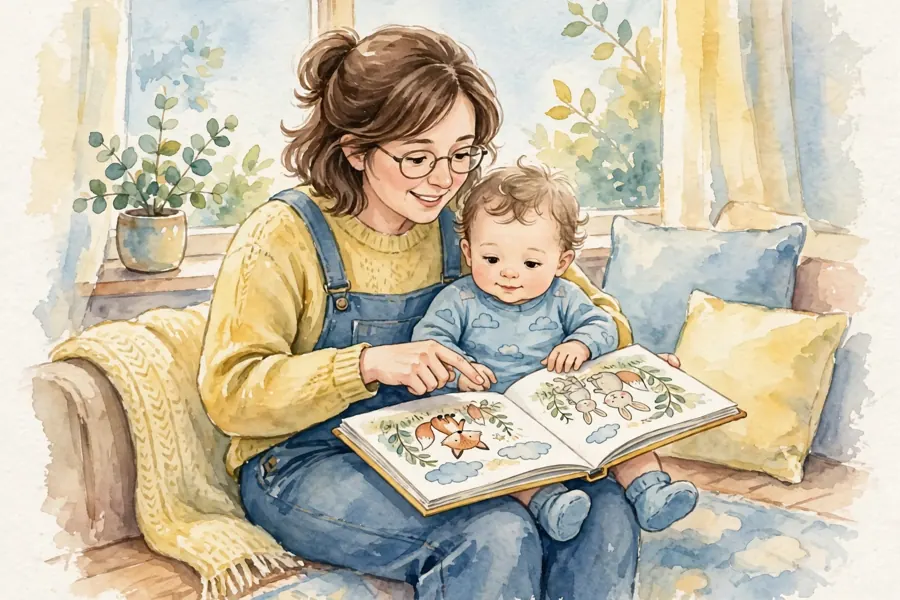
Sharing books builds vocabulary, listening and story skills. There is no single right way to do it: point at pictures, name what you see, talk about what might happen next, and let your child hold the book and turn the pages. Re-reading favourites is a good thing — repetition helps children join in, predict words and feel confident.
Sing songs and rhymes
Songs and rhymes have rhythm, repetition and actions built in, which makes their words memorable and fun to join in with. Action songs add gestures too, giving children another way to take part before they can manage all the words.
Play together every day
Even a few minutes of play, where you follow your child’s ideas, is valuable. Join the game, take the role you are given, and let the child lead. Words, turns and stories all grow inside play.
Respond to every attempt to communicate
A look, a point, a sound, a sign, a word — every attempt is communication, and responding warmly teaches the child that communicating works. If your child uses signing, a picture board, a communication book or a speech-generating device, use it together with them, so it becomes a shared way of talking, not just the child’s tool.
Make listening a little easier
When you can, turn off background noise such as the television during meals and chats. Speech is easier to hear, and conversations are easier to join, in a quieter space.
These everyday strategies support every child’s development. If a child is finding communication hard, a speech and language therapist can suggest approaches tailored to that child after an assessment — shaped around the child’s strengths, your family routines and the languages you speak at home.
The school years: language for learning
Starting school does not mean language development is finished. Through the school years, children’s communication keeps growing in important ways:
- Vocabulary expands to include words for school subjects, feelings, ideas and opinions.
- Children learn to follow longer instructions and more complex explanations.
- They explain their thinking, give reasons, and retell events so that someone who was not there can follow.
- Friendships increasingly depend on conversation — chatting, joking, negotiating and sorting out disagreements with words.
- Reading and writing build directly on spoken language: the child who can understand and tell a story aloud is building the same skills they will use on the page.
Parents and teachers each see a different side of a child’s communication, and both views are valuable. Working together helps a child far more than working separately. Helpful steps include:
- Share what you notice. Tell the teacher how your child communicates at home, and ask how they talk, listen and join in at school.
- Agree simple shared strategies. For example, how instructions are given, which key words to practise before a new topic, or how the teacher can give your child time to answer.
- Keep talking and reading at home. Chatting about the school day, sharing books and telling family stories all keep language growing.
- Pass information along. With your consent, reports and advice from any professionals involved can be shared with the school, so everyone is working in the same way.
- Ask about the school’s support route. If concerns come up, schools have ways of arranging extra help and assessments — ask the teacher what the first step is.
When to seek help
Every child has their own pace, and one sign on its own rarely means there is a problem. Still, some patterns are worth acting on. You know your child well — trust what you see. It is worth seeking advice if:
- Your child is much harder to understand than other children of a similar age, or adults who know them well regularly cannot understand what they say.
- Your child’s understanding seems limited — for example, they struggle with everyday instructions or questions that children around them manage.
- Your child seems frustrated, upset or withdrawn when trying to communicate, or appears to have stopped trying.
- Progress seems to have stalled: words, sentences or understanding do not seem to be moving forward over time.
- Your child loses skills they once had — words, sounds or ways of interacting that they used before disappear. Losing skills at any age deserves prompt professional advice.
- Communication difficulties are affecting play, friendships, behaviour or learning.
- You have concerns about your child’s hearing as well as their talking.
- You simply feel worried. Asking for advice is a sensible step, even if the outcome is reassurance.
The usual route is to talk to your child’s doctor or another health professional, or to your child’s teacher, who can point you towards a speech and language therapy assessment. You can also contact a speech and language therapist directly. An assessment looks at how your child understands, talks, plays and interacts, and it helps you understand what support, if any, would help. Asking for an assessment does not commit you to anything — it gives you a clearer picture and a chance to ask questions.
One situation is different, and urgent. If a child suddenly loses speech, or their speech suddenly becomes slurred or very hard to understand, treat this as an emergency and call your local emergency number straight away. Sudden changes like these need urgent medical help.
For general information about child development and communication, you can also visit the World Health Organization and the American Speech-Language-Hearing Association (ASHA), or follow the guidance of your own national health authority.
Questions to ask a therapist
If you arrange an assessment or a first appointment, these questions can help you get the most from it:
- What will the assessment involve, and is there anything we should bring or prepare?
- What are my child’s communication strengths, and which areas need the most support?
- What can we do at home, within our everyday routines, to support our child’s communication?
- How will goals be agreed, and how will we review progress together?
- What might therapy sessions look like, and how can nursery or school be involved?
- What changes should we look out for, and when should we seek advice again?
Frequently Asked Questions
What is the difference between speech and language?
Language is the system of words, sentences and meanings we use to understand and to express ideas. Speech is the physical production of sounds — how clearly we say the words. A child may have difficulty with language, with speech sounds, or with both, and support is shaped around whichever areas need it.
My toddler is hard to understand. Is that typical?
Young children’s speech is often unclear while they are still learning the sounds of their language, and it usually becomes clearer over time as more sounds are mastered. Family members, who know the child’s speech best, often understand far more than visitors do. If people who know your child well regularly struggle to understand them, or their clarity does not seem to be improving, it is worth asking for professional advice.
Does learning two languages slow children down?
No. Bilingual children pass through the same broad stages of development as children learning one language. Mixing words from both languages in one sentence is a normal part of bilingual learning, and a child’s vocabulary is often spread across their languages. If a bilingual child has a genuine language difficulty, it shows in all of their languages, not just one.
Can gestures, signing or picture supports stop a child from talking?
No. Gestures, signing and picture-based supports sit alongside speech rather than replacing it. They reduce frustration by giving the child a way to communicate right now, while speech continues to develop. For children who need them, supports such as picture boards and communication books are a bridge to fuller communication, not a barrier to it.
How can I support my child’s talking at home?
The everyday moments matter most: talk during routines, get face to face, follow your child’s interests, offer choices, wait to give them time to respond, expand on what they say, share books, sing songs and play together. Little and often, woven into normal family life, is the pattern that helps. The strategies section above explains each of these ideas in more detail.
When should I stop waiting and ask for advice?
Any time you are worried is a reasonable time to ask. You do not need to wait for a particular stage or age. Advice is especially important if your child’s progress seems to have stalled, if they are much harder to understand than other children of a similar age, if communication difficulties are affecting their play, friendships or learning, or if they lose skills they once had.
Related guides
- Signs of speech delay in toddlers: what parents notice first
- Late talker or speech delay? How to tell the difference
- Support for children and parents: the For Kids and Parents hub
- Speech and language therapy services for children
- Browse all conditions and topics
A gentle next step
Trying to decide what to do next can feel difficult, and you do not have to work it out alone. If you would like to talk about your child’s communication — what you have noticed, what you are unsure about, and what might help — you are very welcome to get in touch online. There is no obligation and no pressure: just a friendly first conversation, at your pace.
By Hamayal Adnan, Speech-Language Pathologist
This article is for general educational purposes only and is not medical advice. It does not replace an assessment by a qualified speech and language therapist or other healthcare professional. Every person is different. If you have concerns about speech, language, feeding or swallowing, please seek professional advice. In an emergency, call your local emergency number.