

A late talker is a young child whose talking is developing more slowly than other children’s, while their understanding, play and social skills keep moving ahead. A speech delay or language delay usually means a broader pattern, where understanding may be affected as well as talking, or progress is slow across several areas. The two can look similar at first, which is why professionals look at the whole picture rather than at talking alone.
If you have found yourself searching for the difference, you are not alone. This article explains what each term means in plain language, the signs professionals weigh up, and why a child’s progress over time tells us far more than any single snapshot. It cannot say which fits your child — only an assessment can do that — but it can help you see what to watch for and do next. For the bigger picture, our complete guide to child speech and language development is a good place to start.
Key Takeaways
- “Late talker” describes a pattern: talking is slow to get going, while understanding, gestures, play and social interaction keep developing.
- “Speech delay” and “language delay” are broader terms that can involve understanding as well as talking.
- Professionals never judge by word counts alone — they look at understanding, gestures, play, social skills, hearing and, above all, progress over time.
- A slow start, by itself, does not predict a child’s future. What matters is whether communication keeps moving forward.
- You do not need certainty before asking for advice. An assessment gives information and options, whatever it shows.
On this page
- What does “late talker” mean?
- What does “speech delay” mean?
- Late talker or delay? A side-by-side look
- The signs professionals look at
- Why progress over time matters so much
- What an assessment involves
- What support can look like
- What you can do at home now
- When to seek help
- What to do next
- Frequently asked questions
- Related guides
What does “late talker” mean?
“Late talker” is a description, not a diagnosis. It is used for a young child whose spoken language — their expressive language, meaning the words and sentences they use to send messages — is developing more slowly than other children of a similar age, while the rest of their communication looks stronger.
In this pattern, a child typically:
- Understands much more than they say. They follow everyday instructions, recognise familiar words, and respond to questions and routines. This understanding side of language is called receptive language.
- Communicates well without words. They point, wave, show you things, shake or nod their head, and find clever ways to make their needs known.
- Plays and interacts as expected. They enjoy games, pretend play and being with other people, and they share attention with you, looking where you look.
- Keeps making progress. New words arrive slowly, but they do arrive, and understanding keeps growing.
Think of it as one part of communication running behind while the rest moves ahead: the understanding and connection are there — the words are taking longer to come out.
“Late talker” describes how a child looks at a moment in time. It does not explain why talking is slow, and it cannot tell you how things will unfold. That is why professionals pair this description with watching over time.
What does “speech delay” mean?
Families often use “speech delay” for any lateness in talking. Professionals separate two things that are easy to mix up:
- Speech is the physical production of sounds — how clearly a child says words.
- Language is the system of words, sentences and meanings — both understanding language (receptive language) and using it (expressive language).
So when professionals talk about a language delay, they mean language development that is proceeding more slowly, and possibly less typically, than other children’s. Unlike the late talker picture, it may involve:
- Understanding as well as talking. The child may find everyday instructions, questions or stories hard to follow, not just hard to answer.
- Several areas at once. Words, sentences, understanding and sometimes speech clarity may all be developing slowly together.
- A slower rate of progress. New skills appear, but the gap with other children stays the same or grows.
- Part of a wider picture. For some children, language develops differently as part of their overall development.
A delay is also a description rather than an explanation. The word does not tell you the cause, and it does not set a child’s future in stone. What it signals is that the child would benefit from support and monitoring, rather than simply waiting.
In everyday conversation, people swap these terms around loosely, and that is fine. What matters is the pattern underneath: which parts of communication are strong, which are struggling, and how the picture changes over time.
Late talker or delay? A side-by-side look
The table below sums up the patterns professionals compare. Read it as a guide to what is weighed up — not as a checklist for labelling your own child, because real children rarely fit neatly into one column.
| Aspect | More typical of a late talker | More typical of a delay needing support |
|---|---|---|
| Understanding | Follows everyday talk and routines well | Finds instructions, questions or stories hard to follow |
| Gestures | Points, waves, shows and shares things often | Uses fewer gestures, and other skills grow slowly too |
| Play | Enjoys pretend play and copies everyday actions | Play may be repetitive or slow to develop |
| Social interaction | Seeks people out and enjoys turn-taking games | May seem less interested in interaction or joining in |
| Progress over time | Slow but steady: new words and skills keep appearing | Progress is very slow or stalls; the gap widens |
| Overall picture | Talking is the main area lagging behind | Several areas of communication are affected together |

The signs professionals look at
When a speech and language therapist assesses a young child, they are not simply counting words. They build a picture from many pieces of information:
Understanding
Understanding is the foundation of talking — a child cannot use a word they do not yet understand. Professionals watch how a child responds to everyday language without clues from gestures or routines: following an instruction, finding a named object, answering a question. Strong understanding alongside slow talking tells a different story from difficulties in both.
Gestures and non-verbal communication
Long before words, children communicate with their bodies. Pointing to ask for something, pointing to share interest (“look at that!”), waving, nodding and shaking the head are all steps towards talking. A child who gestures richly is showing that the urge to communicate is there.
Play
Play and language grow together. A child who feeds a doll, pretends a block is a phone, or acts out little everyday scenes is practising the ideas that later become sentences and stories. Therapists watch for this kind of pretend play.
Social interaction
Communication is about connection, not just words. Professionals notice whether a child enjoys being with people, shares attention on the same object or activity, takes turns in simple games, and uses eye contact, smiles and sounds to engage others.
Progress over time
Of all the signs, this may be the most telling: is the child moving forward — understanding more this month than last, adding new sounds, gestures or words, even slowly? A steady direction tells a different story from progress that has stalled.
Hearing
Children learn language by hearing it clearly and often. A child who is not hearing speech well — for example during and after ear infections, or when fluid sits behind the eardrum — may take in words less clearly and talk more slowly as a result. A hearing check is therefore often suggested alongside an assessment. You can read more in our guide to the signs of speech delay in toddlers.
Why progress over time matters so much
Parents are often given a single snapshot: what a child can do on one day, in one room. But development is a moving picture, and the direction of travel matters more than any single frame.
Two children can look very alike today — both saying very little — and be on quite different paths. One is gathering understanding, gestures and sounds, and their talking is beginning to follow. The other is finding several parts of communication hard, and their progress is slower across the board. At one moment in time, it can be difficult to tell these apart.
This is also why honest professionals avoid predictions. For some children whose talking starts slowly, language goes on to develop steadily once it gets going. For others, the difficulties continue and support makes a real difference in everyday life. There is no reliable way to know in advance which path a child will take. What you can do is watch progress, support communication every day, and ask for an assessment — because support helps a child communicate now, whichever path they are on.
What an assessment involves
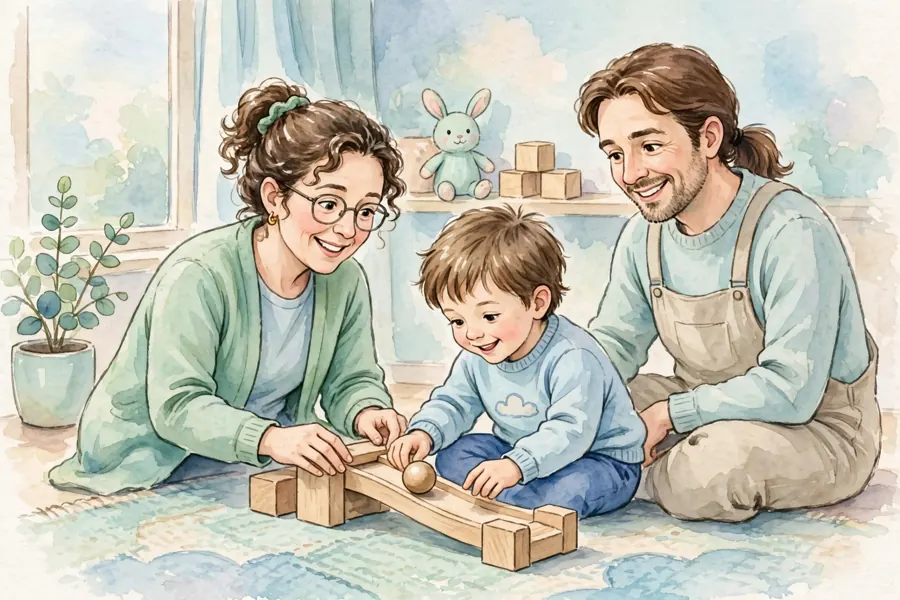
An assessment is not a test a child can pass or fail. It is a friendly, play-based way to understand how a child communicates. In general terms, it involves:
- A conversation with you about your child’s development, health, hearing, family languages, and what you have noticed.
- Play and observation. The therapist plays with your child, watches how they understand, gesture, play and interact, and tries gentle activities suited to their age.
- Listening to any talking the child does — the sounds they use, the words they have, and how they put ideas together.
- Bringing the picture together. The therapist explains what they noticed: your child’s strengths, the areas that need support, and what they recommend next.
That recommendation might be home strategies with a review later, a block of therapy, a hearing check, or referral to another professional — or a combination. Whatever the outcome, you leave knowing more than you did before.
What support can look like
Support is shaped around the individual child, but generally includes two strands working together.
Support at home. Parents and carers are a child’s main communication partners, so much of support is about everyday strategies: creating chances to communicate, responding to a child’s attempts, and building language into routines, play and books. Small changes, used often, add up, and they fit real family life.
Therapy sessions. Where therapy is recommended, sessions are typically play-based for young children and built around agreed goals, such as growing understanding, supporting first words, or helping a child communicate more successfully while speech develops.
Support is never only about words. If a child is frustrated because they cannot make themselves understood, strategies and tools that help them communicate — gestures, signs, pictures — sit alongside work on talking. No honest professional can promise a particular outcome or timescale. What support can do is strengthen communication step by step, starting from where your child is today.
What you can do at home now
Whatever the pattern behind your child’s slow talking, everyday support helps every child. You need no special equipment — just ordinary moments, used well.
- Talk during routines. Name things and describe what you are doing at meals, bath time and getting dressed.
- Get face to face. Come down to your child’s level so you can see each other’s faces.
- Follow their lead. Talk about whatever has caught their interest — children learn words fastest for things they are already looking at.
- Wait. After you speak, pause. Children need time to take in what you said and find a response — a sound, a gesture or a word.
- Offer choices. “The apple or the banana?” gives your child a reason to communicate and a model of the words they need.
- Expand gently. Repeat your child’s message back and add a little: if they say “car”, you might say “yes, a big red car”.
- Share books and songs. Point at pictures, talk about what you see, and enjoy rhymes and action songs together.
- Respond to every attempt. A look, a point, a sound or a word — responding warmly teaches your child that communicating works.

When to seek help
Trust what you see — you know your child well. It is worth asking for advice if:
- Talking is slow to develop and understanding, play or social interaction also seem hard.
- Your child’s progress seems to have stalled: no new sounds, gestures, words or understanding over time.
- The gap between your child and other children of a similar age seems to be growing rather than shrinking.
- Your child seems frustrated, upset or withdrawn when trying to communicate, or appears to have stopped trying.
- You have concerns about your child’s hearing too.
- Your child loses skills they once had — words, sounds or ways of interacting that they used before disappear. Losing skills at any age deserves prompt professional advice.
- You simply feel worried. Asking is always reasonable, even if the outcome is reassurance.
One situation is different, and urgent. If a child suddenly loses speech, or their speech suddenly becomes slurred or very hard to understand, or you notice sudden weakness or a drooping face, treat this as an emergency and call your local emergency number straight away.
For general information, you can also visit the World Health Organization and the American Speech-Language-Hearing Association (ASHA), or follow the guidance of your own national health authority.
What to do next
If you are wondering which pattern your child’s talking follows, these steps will move you forward:
- Write down what you notice. Notes on what your child understands, how they communicate without words, and recent new skills are genuinely useful for any professional you speak to.
- Arrange a hearing check if one has not been done recently, or if you have any doubts about your child’s hearing. Your doctor or local health service can point you to one.
- Talk to your child’s doctor, health visitor or teacher. Tell them what you have noticed and ask about a speech and language therapy assessment. In many places you can also contact a speech and language therapist directly.
- Keep supporting communication at home using the strategies above while you wait.
- Note the direction of travel. Over the coming weeks, jot down new words, gestures or understanding you notice — whether the list grows slowly or not at all, it is valuable information.
Frequently asked questions
Are “late talker” and “speech delay” the same thing?
Not quite. “Late talker” describes talking that develops slowly while understanding, gestures, play and social interaction keep moving ahead. “Language delay” — the professional term behind what families often call speech delay — describes a broader pattern that can involve understanding as well as talking.
Will my child simply grow out of being a late talker?
No one can promise that. Some children whose talking starts slowly go on to develop language steadily; others continue to find it hard and benefit from support. Because this cannot be known in advance, the safest approach is to watch progress over time, support communication at home, and seek an assessment rather than relying on waiting alone.
My child understands a lot but says very little. What does that mean?
Strong understanding alongside slow talking is a real strength to build on. It is only part of the picture, though — professionals also look at gestures, play, social interaction, hearing and progress over time. If talking stays slow, it is still worth asking for advice.
My child uses lots of gestures instead of words. Is that a worry?
Gestures are a healthy part of communication, not a problem. Pointing, waving, showing and nodding show that a child wants to communicate — the very foundation words are built on. Professionals look at whether gestures are varied and growing alongside other skills.
Could hearing be part of the picture?
Yes, it can. Children learn words and sounds by hearing them clearly, and hearing can dip temporarily — for example around colds and ear infections, or when fluid sits behind the eardrum. If you have any doubts, arranging a hearing check is a sensible step, and one is often suggested alongside an assessment.
Should I wait and see, or ask for advice now?
You do not have to choose between the two. You can keep watching progress — and still ask for advice now. An assessment does not commit you to anything; it gives you a clearer picture and ideas for your child. If progress has stalled, skills have been lost, or you are worried, there is no benefit in waiting.
Related guides
- Child speech and language development: a complete guide for parents
- Signs of speech delay in toddlers: what parents notice first
- Support for children and parents: the For Kids and Parents hub
- Online speech and language therapy: how it works
- Frequently asked questions about speech and language therapy
A gentle next step
Trying to work out what your child’s pattern means can feel lonely, and you do not have to do it on your own. If you would like to talk through what you have noticed and what might help, you are very welcome to get in touch online. There is no obligation and no pressure: just a friendly first conversation, at your pace.
By Hamayal Adnan, Speech-Language Pathologist
This article is for general educational purposes only and is not medical advice. It does not replace an assessment by a qualified speech and language therapist or other healthcare professional. Every person is different. If you have concerns about speech, language, feeding or swallowing, please seek professional advice. In an emergency, call your local emergency number.