
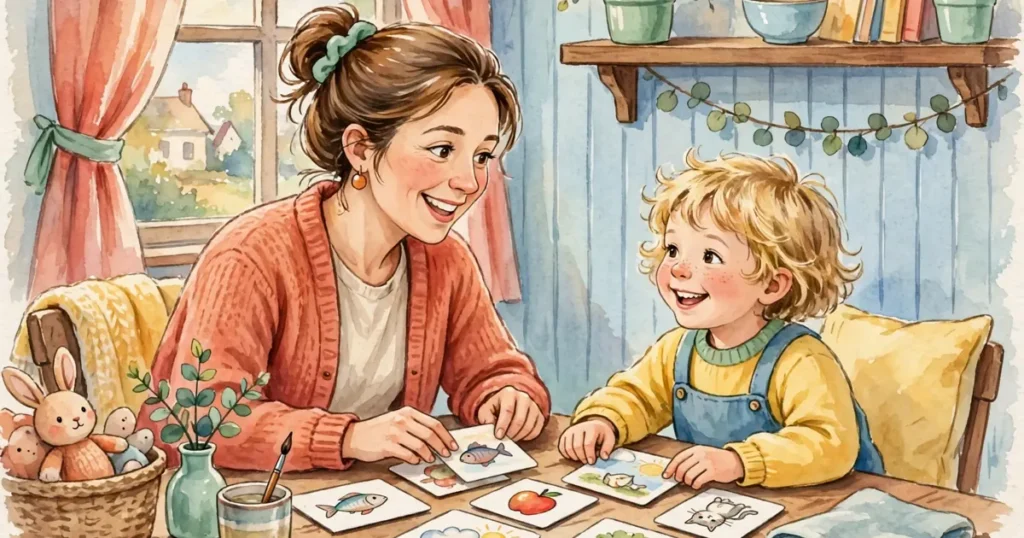
Speech sound disorders are difficulties with producing the sounds of speech clearly and in the right patterns, so that a child’s talking is harder for other people to understand. They include difficulties with making individual sounds, difficulties with the sound patterns of a whole language, and, for some children, a difficulty with planning the movements needed for speech. A speech and language therapist can assess how a child says sounds and explain what kind of support would help.
If your child’s speech is hard to understand, you are in good company. Many parents find themselves quietly “translating” for their child, repeating what their child said so that grandparents, teachers or friends can follow. This guide explains, in plain language, what speech sound disorders are, how they differ from one another, what can contribute to them, and what assessment and therapy usually involve. It also shares gentle, everyday ways you can support your child’s speech at home. It cannot say what is behind your own child’s speech — only an assessment can do that — but it can help you understand the landscape and feel clearer about your next step.
Key Takeaways
- Speech sound disorders are about how clearly a child produces sounds — they are different from language difficulties, which are about words, sentences and understanding.
- There are different kinds: articulation difficulties (individual sounds), phonological difficulties (sound patterns across many words), and childhood apraxia of speech (planning the movements for speech).
- Young children naturally simplify words while they are learning, and clarity grows gradually. What matters is how a child’s clarity compares with other children of a similar age, and whether it keeps improving.
- An assessment looks at the whole picture — sounds, language, hearing, play and understanding — and support is then shaped around the individual child.
- Everyday strategies such as modelling words naturally, recasting what your child says, playing sound games and reading aloud all support clearer speech, without pressure or forced repetition.
- If you are worried about your child’s speech, asking for advice is always a reasonable step.
On this page
- Speech and language: what is the difference?
- How speech sounds develop
- What are speech sound disorders?
- Articulation disorders: how individual sounds are made
- Phonological disorders: patterns in sounds
- Childhood apraxia of speech: a brief overview
- What can cause speech sound difficulties?
- How speech sound difficulties can affect everyday life
- What an assessment involves
- Therapy approaches for speech sounds
- Supporting clear speech at home
- Bilingual children and sound systems
- When to seek help
- Questions to ask a therapist
- Frequently asked questions
- Related guides
Speech and language: what is the difference?
It helps to start with two words that are often mixed up: speech and language.
Speech is the physical production of sounds — how clearly we say words using the breath, voice, lips, tongue, jaw and teeth. Speech is about the sounds themselves: whether a sound is made accurately, and whether sounds combine smoothly into words.
Language is the system of words, sentences and meanings. It includes understanding language (sometimes called receptive language) — making sense of the words, questions and stories we hear — and using language (expressive language) — choosing words and building sentences to share our own ideas.
A child can have a difficulty in one area, the other, or both:
- One child may have lots to say, with strong language, but be hard to understand because their speech sounds are unclear.
- Another may say sounds clearly but have few words, or find sentences and understanding hard.
- A third may have difficulties with both speech and language together.
This guide is about the speech side: how sounds are made, and what happens when that part of communication is difficult. Support is shaped around whichever areas a child needs, so understanding the distinction helps you follow what a professional is describing.
How speech sounds develop
Learning to say all the sounds of a language is a big job, and it takes time. Children learn sounds gradually: simpler sounds usually come first, and sounds that need finer tongue and lip control come later. Along the way, children need many chances to hear sounds clearly and to practise them in real words, in play and in conversation.
While they are learning, young children simplify words in predictable ways. For example, a child might:
- Leave off the end of a word, so “cup” sounds like “cu”.
- Swap a harder sound for an easier one, such as saying “tat” for “cat”.
- Shorten a long word to the part they can manage.
- Say a sound correctly in one word but not yet in longer words or sentences.
These simplifications are a normal part of learning to talk, and they fade gradually as the child’s speech system matures. There is no single strict timetable for this. Children master sounds at different speeds, and clarity grows in steps rather than all at once.
A helpful way to think about clarity is comparison and progress rather than fixed rules:
- Compared with other children of a similar age: is your child’s speech roughly as clear as their playmates’ speech, or noticeably harder to follow?
- Compared with your child’s own past: is their clarity improving over time, with new sounds appearing and more words becoming understandable?
- Who can understand them: familiar adults usually understand a young child first, because the family has learned the child’s own version of words. Over time, people outside the family — teachers, friends, visitors — understand more and more.
Hearing plays a central part in all of this. Children fine-tune their sounds by listening to how words sound when other people say them, and by hearing their own attempts. A child who is not hearing speech clearly may take longer to sharpen their sounds, which is why hearing is always part of the picture when speech is unclear.

What are speech sound disorders?
A speech sound disorder is a difficulty with producing speech sounds that goes beyond the usual simplifications of learning to talk — for example, when sounds are not developing as expected for a child’s age group, when simplifications stay long after other children of a similar age have moved past them, or when a child’s clarity is not improving over time.
Speech sound disorders are an umbrella. Underneath it sit several different kinds of difficulty, and telling them apart matters, because each kind responds to a different kind of support:
- Articulation disorders are about making individual sounds. The difficulty is in the physical production of one or a few particular sounds.
- Phonological disorders are about sound patterns. The child can often make the sounds, but uses them in simplified patterns across many words, which affects whole groups of words at once.
- Childhood apraxia of speech is about planning and sequencing the movements for speech. The child may know what they want to say but find it hard to get the mouth movements organised, especially in longer words.
Some children have more than one kind of difficulty at the same time, and the picture can only be sorted out by listening carefully to the child’s speech across many words and situations. That is what an assessment is for. The sections below explain each kind in turn.
| Type of difficulty | What it can sound like | What support often focuses on |
|---|---|---|
| Articulation difficulty | One or a few sounds are consistently made in an unusual way, while most other sounds are clear | Learning how to position the lips, tongue and jaw for the tricky sound, then practising it in words and sentences |
| Phonological difficulty | Patterns affect many words at once — for example, sounds made at the back of the mouth are replaced by sounds made at the front, so several words sound similar | Helping the child hear and understand the difference between sounds, and use the right sound patterns in words |
| Childhood apraxia of speech | Speech can be inconsistent — a word may come out differently each time — and longer words are especially hard | Building the movement plans for speech through frequent, structured practice with plenty of feedback |
Articulation disorders: how individual sounds are made
An articulation disorder is a difficulty with physically producing one or a few speech sounds. Articulation means the movements of the speech organs — lips, tongue, teeth, jaw and palate (the roof of the mouth) — that shape sounds. Most of a child’s sounds may be perfectly clear, while one particular sound is consistently made in a different way.
Everyday examples include:
- A sound being replaced by a neighbouring sound the child finds easier to make.
- A sound being produced in an unusual position, so it sounds distorted rather than like a different sound — a “slushy” quality to a sound is a common way parents describe this.
- A sound being left out in certain positions in words.
Because the difficulty is narrow, speech with an articulation difficulty is often mostly understandable, with particular words being tricky. The child usually knows what the word should sound like — the challenge is in the mouth movements themselves.
Support for articulation difficulties usually begins with helping the child discover how the sound is made: where the tongue goes, what the lips do, whether the voice is on or off, and how the sound feels and sounds. The new sound is then practised step by step — first on its own, then in syllables, words, phrases and everyday conversation — always at the child’s pace and woven into games and activities so practice stays enjoyable.
Phonological disorders: patterns in sounds
A phonological disorder is a difficulty with the sound system of a language — the patterns and rules for how sounds combine to make words. Phonology is the part of language that organises sounds: which sounds a language has, and how they contrast with one another so that words mean different things. “Cat” and “tat” mean different things only because the starting sounds differ; a child learning language has to learn all of these contrasts.
In a phonological disorder, the child can often physically make the sounds — you may hear the sound said correctly in some words. The difficulty is in how sounds are used across words. The child applies simplifying patterns, called phonological processes, to whole groups of words at once. These patterns are a normal part of early learning, but in a phonological disorder they stay in use longer than expected, or unusual patterns appear.
Common patterns parents might notice include:
- Fronting: sounds normally made at the back of the mouth are replaced by sounds made at the front, so “cat” may sound like “tat” and “go” may sound like “doe”.
- Stopping: long, flowing sounds are replaced by short, abrupt ones, so “sun” may sound like “tun” and “zoo” may sound like “doo”.
- Final consonant deletion: the last sound of a word is left off, so “cup” may sound like “cu” and “bus” may sound like “bu”.
- Cluster reduction: when two consonant sounds sit together, one is dropped, so “spoon” may sound like “poon” and “blue” may sound like “bue”.
- Weak syllable deletion: in longer words, an unstressed syllable disappears, so “banana” may sound like “nana”.
When several patterns are at work together, many different words can end up sounding the same, and speech becomes genuinely hard for listeners to follow — even though the child may be bright, understand a great deal, and have plenty to say.
Support for phonological difficulties focuses on the sound system rather than on mouth movements alone. It often involves listening work, so the child learns to hear the difference between sounds, and word games built around contrasts — for example, practising pairs of words that differ by only one sound — so the child learns that changing the sound changes the meaning, and begins to use the patterns in their own talking.
Childhood apraxia of speech: a brief overview
Childhood apraxia of speech (often shortened to CAS) is a motor speech disorder — a difficulty with planning and sequencing the movements needed for speech. The muscles themselves are not weak. Instead, the difficulty lies in the brain’s planning of the precise, rapid movements of the jaw, lips and tongue, and in putting those movements in the right order for words and sentences.
Because the difficulty is with planning rather than with knowledge, a child with CAS may:
- Say the same word in different ways on different attempts, because the movement plan does not come out the same way twice.
- Find longer words and sentences much harder than short ones, because there are more movements to plan and order.
- Pause, grope or visibly search for the right mouth position when starting to speak.
- Have speech that is especially hard for unfamiliar listeners to understand.
- Understand far more than they can say, which can be frustrating for the child.
CAS is less common than articulation and phonological difficulties, and it needs careful assessment to identify, because some of its features overlap with other speech sound difficulties. Support for CAS looks different too: it usually involves frequent, focused practice of speech movements, with an approach built around movement practice rather than sound patterns alone.
This guide gives only an overview. For more detail, read our guide to the signs of childhood apraxia of speech, and our comparison of childhood apraxia of speech and speech delay.
What can cause speech sound difficulties?
There is no single answer, and often there is no clear cause at all. Professionals group the possible contributions into two broad kinds.
Functional difficulties
Many speech sound difficulties are described as functional, which means no clear physical cause is found. The child’s speech system is developing differently or more slowly in how it organises and produces sounds, without an obvious structural reason. Family patterns can be part of the picture — speech sound difficulties sometimes appear in more than one person in a family — but for many children, no explanation is ever identified, and that is common and normal. A functional difficulty is just as real, and just as deserving of support, as any other.
Organic and structural contributions
Organic means there is an identifiable physical or developmental factor involved. In general terms, these can include:
- Hearing. A child who has not been hearing speech clearly — for example during repeated ear infections, or when fluid sits behind the eardrum for a while and dulls sounds — may learn sounds less sharply. Hearing can dip and recover, so a hearing check is often suggested when speech is unclear.
- The structures of the mouth. The palate (roof of the mouth), teeth, tongue and jaw all shape sounds. Differences in these structures, or in how they work together, can make some sounds harder to produce. Most structural differences are straightforward ones that many children have, and a professional can advise whether anything needs a closer look.
- Overall development. For some children, speech sounds develop differently as part of a wider developmental picture, and support is shaped around the whole child rather than speech alone.
- Motor planning. In childhood apraxia of speech, described above, the contributing difficulty is in planning movements rather than in the structures themselves.
Whatever the contribution, the starting point is the same: a careful look at how the child produces sounds now, and support that builds from there. If a physical factor needs attention — such as hearing — the therapist can point you towards the right service, and speech support can continue alongside it.
How speech sound difficulties can affect everyday life
Speech is how children share needs, ideas, jokes and feelings. When speech is hard to understand, the effects can reach beyond the sounds themselves. Not every child is affected in these ways, and many children with unclear speech are confident and thriving — but it helps to know what to watch for.
Confidence
A child who is often misunderstood may have to repeat themselves, or watch a listener turn to a parent for a “translation”. Over time, some children become quieter in groups, avoid putting a hand up, or let others speak for them. Others become frustrated when a message does not get across, and that frustration can show up in behaviour. Gentle, patient listening — and celebrating what the child is trying to say, not only how clearly they say it — protects confidence while speech work continues.
Friendships
Play and friendship run on talk: suggesting a game, joining in pretend play, telling a friend what happened, sorting out small disagreements. A child whose speech is hard to follow may find it harder to join in, keep a game going, or be understood by new friends who have not yet learned their speech. Supportive adults can help by modelling how to listen, giving the child time, and building play opportunities where communication can succeed.
Early literacy
Reading and writing build on the sound system of spoken language. Learning to read involves connecting letters to sounds, and sounding out words; spelling involves breaking words down into their sounds. A child whose sound system is still developing differently may find some of these early literacy steps harder, and may benefit from support that keeps spoken sounds and early reading skills growing together. This is one reason speech and language therapists and teachers often work in partnership, and why sharing information between them — with your consent — helps your child.
None of this means a child with a speech sound difficulty will struggle in these areas. It means these areas are worth keeping an eye on, so that support can be offered early and kindly if it is needed.
What an assessment involves
An assessment is a careful, friendly exploration of how your child communicates. It is not a test a child can pass or fail. In general terms, a speech sound assessment involves:
- A conversation with you about your child’s development, health, hearing, the languages spoken at home, and what you have noticed about their speech — including which words are tricky and who understands them best.
- Listening to your child’s speech in play and conversation. The therapist plays and chats with your child, listening to how they produce sounds naturally rather than only in single words.
- Structured sound tasks. The therapist may ask your child to name pictures or repeat words chosen to sample all the sounds of the language in different positions — at the start, middle and end of words — and in longer words and sentences. This shows which sounds are present, which are developing, and whether patterns are at work.
- Looking at how the mouth works. The therapist may watch your child’s lips, tongue and jaw in play and in simple movements, and note anything about the structures of the mouth that seems relevant.
- Considering the wider picture. Understanding, language, play and social communication are usually looked at too, because speech is one part of communication, and because patterns across areas help identify the kind of difficulty.
- Bringing it together. The therapist explains what they found: your child’s strengths, the kind of speech sound difficulty that seems to be present, what may be contributing, and what they recommend next.
Recommendations might include therapy sessions, a home practice plan, strategies for nursery or school, a hearing check, or referral to another professional — or a combination of these. Whatever the outcome, you should leave understanding your child’s speech better than when you arrived.
Therapy approaches for speech sounds
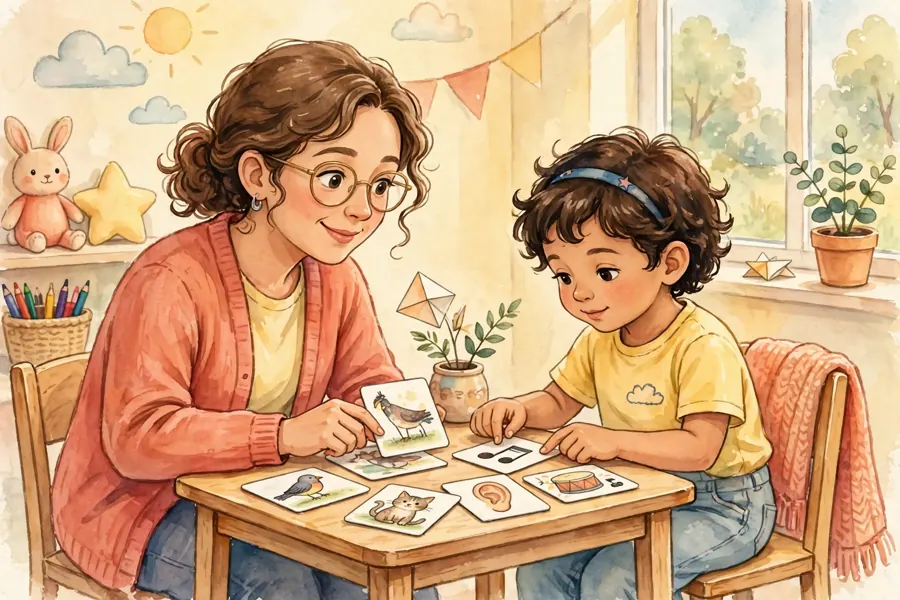
Therapy is shaped around the kind of difficulty a child has, their age, and what motivates them. Sessions for young children are usually play-based, with practice hidden inside games, stories and activities. Approaches you may hear about include:
- Listening and discrimination work. Before a child can reliably produce a sound or pattern, they usually need to hear it clearly. Listening games help the child notice the difference between sounds — for example, hearing that “cat” and “tat” start differently — and recognise when a sound is said correctly or incorrectly in someone else’s speech.
- Sound practice in play. For articulation difficulties, the child learns how the tricky sound is made, then practises it step by step — in isolation, in syllables, in words, in phrases and in conversation — inside games and activities so that practice feels like play rather than a lesson.
- Working with contrasts. For phonological difficulties, therapy often uses pairs of words that differ by one sound, so the child experiences how changing a sound changes meaning, and learns to use the new pattern in their own words.
- Approaches for childhood apraxia of speech. Where CAS is present, therapy focuses on the movement plans for speech, with frequent practice and feedback. Two approaches you may come across are DTTC (Dynamic Temporal and Tactile Cueing) and PROMPT, both of which support the child in building accurate speech movements with structured cues. These are described in general terms on our Therapy Approaches page.
Progress in speech therapy is usually gradual, and it varies from child to child. Sounds often become clearer in structured practice first, then in everyday talking. Home practice, little and often, is usually part of the plan — the therapist will show you exactly what to practise and how, so you are never left guessing.
Supporting clear speech at home
You do not need special equipment or teaching skills to support your child’s speech. The most powerful support happens in ordinary moments, with a few simple habits. These ideas support every child; if your child is having therapy, your therapist may add specific practice to them.
- Model words naturally. Say words clearly and naturally in everyday talk, so your child hears good examples many times a day. You do not need to slow down unnaturally or exaggerate — just clear, ordinary speech.
- Recast rather than correct. If your child says a word unclearly, repeat the word back in its correct form as a natural part of the conversation. If they say “tat” for the cat, you might say “yes, the cat is sleeping”. Your child hears the right version without feeling corrected.
- Do not force repetition or correction. Asking a child to “say it properly” or repeat a word again and again can make talking feel like a test, and can dent confidence. Children learn sounds through hearing them, through gentle practice in games, and through time — not through pressure. If you are unsure whether the message was “cat” or something else, it is fine to check the meaning warmly (“show me what you mean”) rather than correcting the sound.
- Play listening and sound games. Rhyming games, silly sound play, “I spy” with starting sounds, and games where you spot whether a word sounds right or wrong all sharpen listening. Keep them playful and short.
- Read aloud together. Sharing books gives your child rich listening, new words and many chances to hear sounds in stories. Point at pictures, enjoy rhymes and repeated phrases, and let your child join in with the parts they know.
- Give time and listen to the message. When your child talks, listen to what they are saying first. Getting down to their level, waiting while they find their words, and responding to the message itself tells your child their talking is worthwhile.
- Keep practice playful and brief. If your therapist gives you words or sounds to practise, weave them into games, routines and books, a little at a time, and stop while it is still fun.

Bilingual children and sound systems
Many children grow up hearing and speaking two or more languages, and each language has its own set of sounds and its own sound patterns. A bilingual child is therefore learning two sound systems at once — a big and very worthwhile job.
A few points are reassuring to know:
- Learning two languages does not cause speech sound disorders. Bilingualism does not confuse children or hold back their speech.
- Sounds can transfer between languages. A child may use a sound pattern from one language in the other, because the sound systems are still being sorted out. This is a normal part of bilingual learning.
- Patterns differ between languages. A sound that exists in one language may not exist in the other, and each language will need its sounds learned in its own words.
- A genuine difficulty shows in both languages. If a child does have a speech sound difficulty, signs of it appear across the languages they speak — not in just one. Difficulty in one language only is more often about still learning that language’s sounds.
- Use the language you speak best. Children learn sounds and words from rich, natural talk. The language you are most fluent and comfortable in is the best one for chatting, playing and reading together.
If you seek an assessment for a bilingual child, tell the therapist which languages are spoken at home and by whom. An assessment that takes all of the child’s languages into account gives the fairest picture of their speech.
When to seek help
Every child develops at their own pace, and one unclear sound on its own rarely means there is a difficulty. Still, some patterns are worth acting on. You know your child well — trust what you see. It is worth seeking advice if:
- Your child is much harder to understand than other children of a similar age, or adults who know them well regularly cannot follow what they say.
- Your child’s clarity does not seem to be improving over time, even though they are getting older and talking more.
- Simplifying patterns that other children of a similar age have grown out of are still present in most of your child’s talking.
- Your child’s speech sounds inconsistent — the same word comes out in different ways — or longer words are especially hard for them.
- Your child seems frustrated, upset or withdrawn when trying to communicate, or avoids talking in some situations.
- Speech difficulties seem to be affecting play, friendships, confidence or early learning.
- You have concerns about your child’s hearing as well as their speech.
- You simply feel worried. You do not need to be certain before asking — advice and reassurance are both good outcomes.
One pattern deserves prompt advice at any age: losing skills. If your child stops using sounds, words or ways of communicating they had before, seek professional advice promptly.
One situation is an emergency. If a child suddenly loses speech, their speech suddenly becomes slurred or very hard to understand, their face suddenly droops on one side, or they have sudden weakness, choking or difficulty breathing, call your local emergency number immediately.
The usual first step is to talk to your child’s doctor or another health professional, or to their health visitor or teacher if you have one. You can also contact a speech and language therapist directly. For general information, you can visit the American Speech-Language-Hearing Association (ASHA) or the World Health Organization, or follow your national health authority’s guidance. You can also explore our hub for children and parents for more guides on supporting communication at home.
Questions to ask a therapist
If you arrange an assessment or a first appointment, these questions can help you feel prepared:
- What kind of speech sound difficulty does my child seem to have, and how did you tell?
- Which sounds or patterns will therapy focus on first, and why those?
- What will sessions look like, and how will practice be built into play?
- What exactly should we practise at home, how often, and how will you show us?
- Should my child’s hearing be checked, and how do we arrange that?
- How will we review progress together, and what changes should we watch for?
Frequently asked questions
What is the difference between an articulation disorder and a phonological disorder?
An articulation disorder is about physically making one or a few individual sounds — the mouth movements for a particular sound are difficult. A phonological disorder is about the sound patterns of the language: the child may be able to make the sounds, but uses them in simplified patterns across many words, so whole groups of words are affected. An assessment listens to a child’s speech across many words to tell the two apart, because support differs for each.
My child is hard to understand. Is that typical?
Young children’s speech is naturally unclear while they are learning the sounds of their language, and it usually becomes clearer gradually as more sounds are mastered. Family members often understand far more than visitors, because they know the child’s version of each word. What is worth acting on is speech that is noticeably harder to follow than other children of a similar age, clarity that is not improving over time, or a child who is becoming frustrated. If you notice those, asking for advice is a sensible step.
Will my child’s speech sounds sort themselves out?
Some early simplifications fade on their own as children mature, and others continue and benefit from support. No one can tell in advance which path an individual child will take, which is why an assessment is helpful: it identifies the kind of difficulty and whether support is recommended now, or monitoring with advice is the right first step. Seeking advice does not commit you to therapy — it gives you a clearer picture.
How can I help my child say sounds more clearly at home?
Model words naturally, and recast what your child says by repeating it back in its correct form within the conversation, rather than correcting them or asking them to repeat it. Play listening and sound games, read aloud together, and give your child time to talk while you listen to their message. If your child has therapy, your therapist will show you any specific practice to do at home. Pressure and forced repetition are best avoided — they tend to make talking feel like a test.
Does speaking two languages make speech sounds harder?
No. Bilingual children learn the sound systems of both of their languages, and patterns from one language sometimes appear in the other while the systems are being learned — that is normal. Learning two languages does not cause speech sound disorders. If a genuine difficulty is present, it shows in all of the child’s languages, and an assessment should take every language into account.
What is childhood apraxia of speech, in brief?
Childhood apraxia of speech is a difficulty with planning and sequencing the movements for speech. The muscles are not weak; the challenge is organising the movements, so speech can sound inconsistent, longer words can be especially hard, and a child may visibly search for the right mouth position. It needs careful assessment to identify, and support focuses on building speech movement plans through frequent, structured practice. Our linked guides above explain it in more depth.
Related guides
- Signs of childhood apraxia of speech
- Childhood apraxia of speech or speech delay? How to tell the difference
- Support for children and parents: the For Kids and Parents hub
- Therapy approaches explained
- Browse all conditions and topics
A gentle next step
Living with a child whose speech is hard to understand can feel tiring and worrying, and you do not have to work out what it means on your own. If you would like to talk about your child’s speech — what you have noticed, what you are unsure about, and what might help — you are very welcome to get in touch online. There is no obligation and no pressure: just a friendly first conversation, at your pace.
By Hamayal Adnan, Speech-Language Pathologist
This article is for general educational purposes only and is not medical advice. It does not replace an assessment by a qualified speech and language therapist or other healthcare professional. Every person is different. If you have concerns about speech, language, feeding or swallowing, please seek professional advice. In an emergency, call your local emergency number.