

A speech delay means a child’s sounds, words or language are developing more slowly, but broadly in the usual pattern. Childhood apraxia of speech (CAS) is different: it is a difficulty with planning the movements needed for speech, so words often come out inconsistently, and moving smoothly from one sound to the next is the real struggle. The two can look similar from the outside, which is why a professional assessment is the way to tell them apart.
Parents often meet these two terms together, sometimes in the same sentence, and it is easy to feel unsure which one fits. This article explains each term in plain language and sets the two side by side. It cannot say which pattern your own child shows — only an assessment can do that — but it can help you understand the words and what to do next.
Key Takeaways
- A speech delay usually follows the typical pattern of development, just more slowly. Apraxia of speech involves difficulty planning the movements of speech itself.
- Inconsistency is a key clue: a child with apraxia may say the same word differently each time they try.
- Vowel sounds, longer words and new words are often especially hard in apraxia, while familiar phrases like songs may sound easier.
- Only a speech and language therapist, listening across many words and over time, can tell the two apart reliably — and the difference matters, because therapy is planned differently for each.
- Whatever the pattern, communication comes first — gestures, signs and picture supports help a child share messages while speech develops.
On this page
- What is a speech delay?
- What is childhood apraxia of speech?
- Apraxia and speech delay side by side
- Why the difference matters
- Why only a professional assessment can tell
- What an assessment involves
- What therapy may look like
- Supporting your child, whichever pattern they show
- When to seek help
- What to do next
- Frequently asked questions
- Related guides
What is a speech delay?
“Speech delay” is a general term families use when a child’s talking is developing more slowly than other children of a similar age. Professionals look more closely, because slower talking can involve speech sounds, language, or both.
Articulation difficulties
Articulation is how the tongue, lips, jaw and voice physically make each sound. A child with an articulation difficulty may struggle with one or a few particular sounds — for example, a sound that needs a tricky tongue position — while the rest of their speech is clearer. The errors tend to be the same each time.
Phonological delay
Phonology is the pattern system of sounds in a language — the rules children gradually learn about how sounds fit together in words. Young children naturally simplify words in predictable ways while they learn these patterns: saying the first sound of a word twice, dropping the last sound of words, or using simpler sounds in place of harder ones.
In a phonological delay, these younger patterns stay in place for longer than expected, but they are usually consistent — the child simplifies words in the same ways again and again. Because the pattern is predictable, familiar listeners can often work out what the child means, and therapy typically works on the sound patterns themselves.
What is childhood apraxia of speech?
Childhood apraxia of speech, often shortened to CAS, is a motor speech difficulty. “Motor” here means movement. To speak, the brain has to plan a fast, precise sequence of movements — lips, tongue, jaw and voice working together, sound after sound. In CAS, the difficulty lies in that planning and organising, not in muscle strength: the muscles themselves usually work normally for eating, smiling and other everyday movements.
Because the planning is the hard part, speech can be inconsistent. A child with CAS might:
- Say the same word in different ways on different attempts, so errors do not follow a set pattern.
- Find vowel sounds — the open sounds in the middle of words, like the “a” in “cat” — hard to get right, which is less typical in other speech difficulties.
- Pause, hesitate or visibly search for the right mouth position, sometimes moving the lips or tongue before a sound comes out. This searching is sometimes called groping.
- Say a familiar, well-practised word quite clearly, yet struggle with a new word of similar length.
- Find longer words much harder than short ones, with sounds or syllables dropping out or swapping around.
- Sound smoother in automatic phrases — counting, singing a well-known song, or an everyday phrase — than when putting new sentences together.
Children with CAS usually know what they want to say, and many understand a great deal — the difficulty is getting the words out. That gap can be frustrating, which is why the communication supports described later in this article matter so much.

Apraxia and speech delay side by side
The table below sums up the patterns professionals compare. Read it as a guide to what is weighed up during an assessment — not as a checklist for deciding about your own child, because real children rarely fit neatly into one column, and the two patterns can overlap.
| Aspect | More typical of a speech delay | More typical of childhood apraxia of speech |
|---|---|---|
| Consistency of errors | Errors follow a pattern: the same sound is simplified in a similar way each time | Errors are inconsistent: the same word may come out differently each time |
| Vowel sounds | Vowels are usually accurate, even when other sounds are unclear | Vowel sounds are often distorted or change from try to try |
| Familiar vs new words | Familiar and new words are affected in similar ways | Well-practised words may be clearer; new words are often much harder |
| Effort and searching | Speech flows without much visible searching for sounds | The child may grope, hesitate or visibly search for the right mouth position |
| Longer words | Longer words are simplified in predictable ways | Longer words are often much harder, with sounds or syllables missing or swapped |
| Singing and counting | Songs and counting sound much like everyday speech | Singing, counting and set phrases may sound smoother than new sentences |
No single row in this table decides anything on its own. Professionals look at the whole pattern together, alongside the child’s understanding, play and progress over time.
Why the difference matters
The two patterns are supported in different ways, so understanding which one a child shows helps a therapist plan therapy that matches the difficulty. For a phonological delay, therapy works on the sound patterns of language — helping a child hear how sounds differ and reorganise the patterns they use. For CAS, therapy is built on motor learning, the way we learn any skilled movement: intensive practice of the movements of speech themselves, so they gradually become more automatic.
Choosing the wrong focus can waste valuable time: pattern-based work alone may not help a child whose main struggle is planning movements, and movement-based practice alone may not address sound patterns. This is why an accurate picture matters before therapy is planned.
Why only a professional assessment can tell
It is tempting to compare your child’s speech with a list of signs, but there are good reasons why this difference can only be judged properly in an assessment.
The patterns overlap. Both can make a young child very hard to understand, with few words, unclear sounds and frustration. A toddler with very little speech may not yet say enough for anyone to judge consistency, vowels or movement planning reliably.
Consistency has to be tested, not guessed. A therapist listens to the same words several times, across many different words and phrases, to see whether errors stay the same or change. They try words of different lengths, familiar phrases and new combinations, listening carefully to vowels and to how the child moves between sounds.
Time matters. Sometimes the clearest picture emerges over several sessions, as the child relaxes and says more. A therapist may suggest support that helps either way and keep the question open until there is enough speech to judge. An early description may be refined later — that is normal, not a mistake.
What an assessment involves
An assessment is a friendly way of building a picture of how a child communicates. In general terms, it involves:
- A conversation with you about your child’s development, health, hearing, the languages your family speaks, and what you have noticed.
- Play and conversation. For young children, much of the assessment happens through play, books and everyday activities, so the child can relax and communicate naturally.
- Careful listening to speech. The therapist listens to the sounds a child uses, how consistent their words are, how vowels sound, and how they manage words of different lengths. They may ask the child to copy words, and to try the same word more than once.
- Checking understanding, play and interaction too, because speech is only one part of communication.
- Bringing the picture together. The therapist explains what they noticed, what the pattern suggests, and what they recommend next — which might be therapy sessions, home strategies with a review later, a hearing check, referral to another professional, or a combination.
What therapy may look like
If the pattern is a speech delay
Sessions often play with sound patterns: listening for differences between sounds, sorting words by their sounds, and practising target patterns in games, books and conversation. Practice at home, as guided by the child’s therapist, usually involves short, playful activities built into everyday routines.
If the pattern is childhood apraxia of speech
Sessions focus on the movements of speech. The therapist chooses a small set of useful words or phrases and practises the movements for them many times, in a supportive way, using cues the child can see, hear and feel. New words and longer phrases are added gradually as movements become more reliable. Therapy may continue for longer, and progress is often steady rather than sudden — each new word the child can say reliably is a genuine achievement.
For both patterns, sessions for young children are play-based and positive, and parents are partners in the process. No honest professional can promise a particular outcome or timescale. What therapy aims to do is build clearer, more confident communication step by step.
Supporting your child, whichever pattern they show
While you wait for advice, and alongside any therapy, the everyday support that helps is much the same for both patterns.
- Keep communication first. The goal of every interaction is sharing a message, not perfect sounds. Respond to what your child means, not only to how clearly they said it.
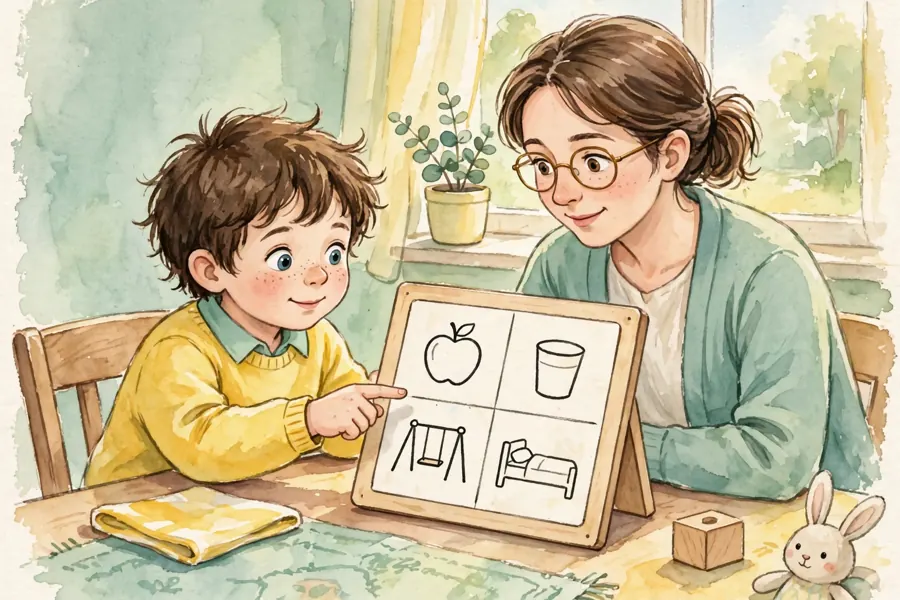
- Use every way of communicating. Gestures, signing and pointing to pictures on a communication board or in a communication book all count as real communication. These supports sit alongside speech, giving your child a way to share messages now, while speech develops — and often reduce frustration for everyone.
- Celebrate attempts. Trying to say a word takes effort, especially for a child who finds speech planning hard. Warm responses — even to unclear attempts — encourage a child to keep trying.
- Give time and reduce pressure. Avoid asking a child to “say it again properly”. Instead, say the word back naturally yourself, so they hear a clear model without feeling corrected.
- Practise only as guided. If your child’s therapist suggests practice at home, they will show you what to do: short, happy practice within routines is the usual pattern. If practice becomes a battle, mention it at the next session rather than pushing on.

When to seek help
It is worth seeking advice about your child’s speech if:
- Your child is much harder to understand than other children of a similar age, and this is not improving over time.
- Familiar adults regularly cannot work out what your child says.
- Your child says the same word differently each time, seems to search for sounds, or finds longer words especially hard.
- Your child’s talking, understanding or play does not seem to be moving forward.
- Your child becomes frustrated, upset or withdrawn when trying to communicate.
- You have concerns about your child’s hearing as well as their talking.
- You simply feel worried. You do not need to be certain which pattern fits, or to wait for a particular stage.
One pattern deserves prompt advice at any age: losing skills. If your child stops using words, sounds or ways of interacting that they had before, seek professional advice promptly.
One situation is an emergency. If a child suddenly loses speech, their speech suddenly becomes slurred or very hard to understand, their face suddenly droops on one side, or they have sudden weakness, choking or difficulty breathing, call your local emergency number immediately.
The usual first step is to talk to your child’s doctor or another health professional, or to a health visitor or teacher if you have one. You can also contact a speech and language therapist directly. For general information, visit the American Speech-Language-Hearing Association (ASHA), or follow your national health authority’s guidance. For the signs professionals look for in apraxia specifically, see our guide to the signs of childhood apraxia of speech.
What to do next
If you are wondering which pattern your child’s speech follows, these steps will move you forward:
- Write down what you notice. Which words are hard, whether the same word changes each time, and which phrases your child says easily — notes like these are genuinely useful for a therapist.
- Record a short video, if your child is comfortable. A minute of everyday talking at home can show things that may not appear in a clinic room.
- Arrange a hearing check if one has not been done recently, or if you have any doubts about your child’s hearing.
- Ask for a speech and language therapy assessment. Mention what you have noticed, including anything that sounds like the apraxia pattern — inconsistency, searching for sounds, or difficulty with longer words.
- Keep supporting communication at home using the ideas above while you wait, and celebrate every attempt your child makes.
Frequently asked questions
Can a child have both apraxia and a language delay?
Yes, the difficulties can overlap. A child may find speech movement planning hard and also be developing understanding or vocabulary more slowly. An assessment looks at every part of communication, and therapy can support each area a child needs.
Will my child grow out of apraxia or a speech delay?
No one can promise what will happen for an individual child. Some children with a speech delay make steady progress with support, while children with apraxia usually need movement-focused therapy over a longer period. Support helps a child communicate better now, whichever path they are on.
My child sings songs clearly but cannot say new words. Is that apraxia?
It can be one of the patterns professionals notice with apraxia: well-practised, automatic speech such as songs or counting is often easier than putting new words together. On its own it confirms nothing, because there are other possible reasons too. Mention it at an assessment, where it can be weighed up with everything else.
Can a very young child be assessed for apraxia?
A therapist can assess any young child’s communication, but judging apraxia fairly needs enough speech to listen to. With a toddler who says very little, a therapist may support communication first and describe the pattern more precisely as more words appear. Support does not have to wait for a definite label.
Does using pictures or signs mean giving up on speech?
No. Picture supports, signs and gestures sit alongside speech rather than replacing it. They give your child a way to communicate successfully right now, which reduces frustration and keeps conversation going, while therapy continues to build speech.
How long does therapy take?
There is no set timescale, and it varies a great deal between children. It depends on the pattern the child shows, how much speech is affected, and how therapy and home life fit together. Your child’s therapist will agree goals with you and review progress regularly.
Related guides
- Speech sound disorders in children: a complete guide for parents
- Signs of childhood apraxia of speech
- Support for children and parents: the For Kids and Parents hub
- Therapy approaches explained in plain language
- Browse all conditions and topics
A gentle next step
Working out whether your child’s speech pattern is a delay, apraxia, or something else can feel like a heavy thing to carry alone, and you do not have to. If you would like to talk through what you have noticed, you are very welcome to get in touch online. There is no obligation and no pressure: just a friendly first conversation, at your pace.
By Hamayal Adnan, Speech-Language Pathologist
This article is for general educational purposes only and is not medical advice. It does not replace an assessment by a qualified speech and language therapist or other healthcare professional. Every person is different. If you have concerns about speech, language, feeding or swallowing, please seek professional advice. In an emergency, call your local emergency number.