
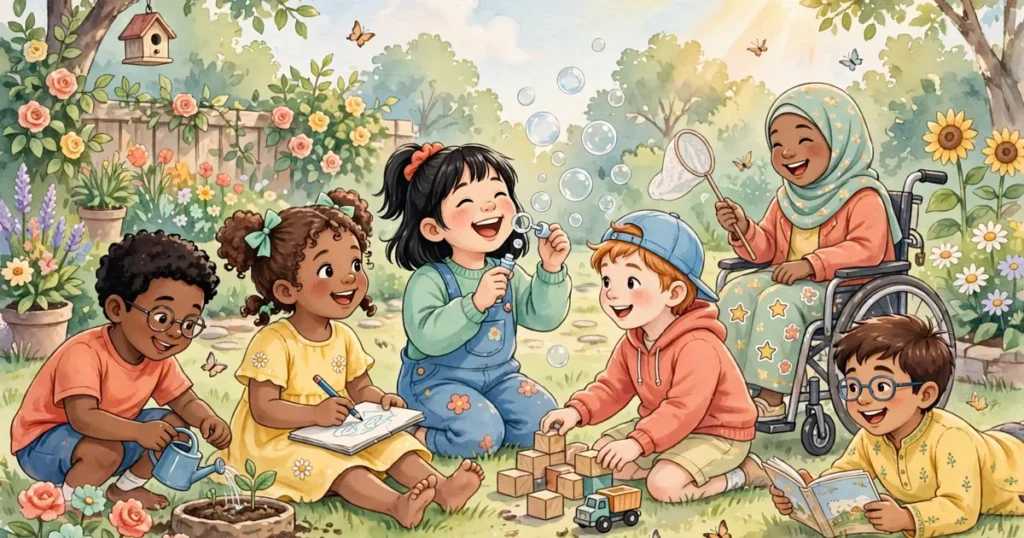
Social communication is the way we use language to connect with other people — chatting, taking turns, reading facial expressions and tone of voice, and understanding jokes, hints and feelings. For autistic children and children with ADHD, this side of communication often works in its own distinctive way, with real strengths alongside areas that can feel harder. Understanding those differences, and building on each child’s strengths and interests, helps families support connection in ways that feel good for everyone.
Every child communicates. Some children talk in long, detailed sentences; some use a few words; some communicate with gestures, pictures, signs or technology — and all of these are real communication. If your child is autistic, has ADHD, or is both, you may have noticed that social interaction does not always follow the pattern you see in other children. That does not mean your child is not communicating, or that they do not want to connect. It usually means their brain experiences conversation, attention and social signals differently — and that the people around them can learn to meet them halfway.
This guide explains social communication in plain language: what it involves, how it can look for autistic children, how it can look for children with ADHD, and where the two overlap. It also looks at one of the most helpful ideas in this area — that behaviour is a form of communication — and shares everyday ways to support your child at home and at school. It cannot say anything about your own child’s individual profile; only an assessment can do that. But it can help you understand the landscape, notice strengths you may already be seeing, and feel clearer about your next step.
Key Takeaways
- Social communication is the connecting side of language: turn-taking, reading cues, joining conversations and understanding jokes, hints and feelings.
- Autistic children and children with ADHD often communicate in distinctive ways. These are differences in how the brain handles interaction and attention, not a lack of caring or effort.
- Every child communicates — through words, gestures, pictures, signing, behaviour or technology — and every form of communication deserves to be heard and built on.
- Behaviour is communication. When adults ask “what might my child be telling me?”, tricky moments often become easier to understand and to support.
- Support works best when it follows the child’s lead and interests, gives processing time, uses visual supports where they help, and celebrates communication in all its forms.
- A speech and language therapy assessment looks at the whole communication profile — strengths as well as needs — and goals are agreed with the family.
On this page
- What social communication means
- How communication can look in autism
- How communication can look in ADHD
- When autism and ADHD overlap
- Behaviour is communication
- Supporting communication at home
- Social communication at a glance
- Communication at school
- How speech and language therapy can help
- When to seek help
- Questions to ask a therapist
- Frequently asked questions
- Related guides
What social communication means
Talking involves more than words and sentences. Alongside the language itself sits a whole set of social skills that help people connect: knowing how to start a conversation, how to keep one going, how to tell when someone is bored or upset, and how to adjust what we say for different listeners. This connecting side of communication is called social communication, and much of it runs on unwritten rules that most people absorb without ever being taught.
Some of the main parts of social communication are:
- Turn-taking. Conversation is a back-and-forth, a bit like a rally in a ball game. It involves listening, pausing, responding and leaving space for the other person — and knowing how to repair things when two people talk over each other.
- Reading cues. A great deal of meaning is carried outside the words: facial expressions, tone of voice, body language, gestures and eye contact. Listeners use these cues to work out whether someone is joking, serious, interested, tired or keen to finish.
- Starting and joining conversations. Knowing how to approach a group, find a moment to join in, choose something to say, and keep a shared topic going — or change it gracefully — are all social communication skills.
- Understanding non-literal language. Everyday talk is full of language that does not mean exactly what it says: jokes, sarcasm, idioms such as “it’s raining cats and dogs”, hints (“it’s getting late” meaning “please go home”) and white lies told to spare feelings.
- Adjusting for the listener. We talk differently to a toddler, a friend, a teacher and a grandparent. Choosing what to say, how much detail to give and how formal to be is part of social communication too.
- Understanding other minds. Conversations work because each person holds in mind what the other person might know, want or feel — and shapes their replies accordingly.
For many people, these skills develop quietly through everyday interaction. For autistic children and children with ADHD, some of these unwritten rules may be processed differently, learned in a different order, or need more energy to use. That is a difference in style and wiring — not a measure of how much a child cares about other people. Many autistic children, for example, connect deeply and loyally; they may simply show it in ways that are easy for others to miss. And many children with ADHD are warm, funny and enthusiastic conversationalists whose brains sometimes run ahead of the conversation itself.
It also helps to remember that social communication is a two-way street. Misunderstandings happen between people whose brains work differently, in both directions: an autistic child may find non-autistic communication styles just as puzzling as the other way round. When families understand this, the goal shifts from “teaching the child to be like everyone else” to building shared understanding — a much kinder and more effective place to start.
How communication can look in autism
Autism shapes the way a child experiences the world, including the social world. Every autistic child is an individual, with their own profile of strengths, interests and needs, so the picture below is a general one — your child may show some of these patterns, none of them, or their own variations.
Differences in social interaction
Some autistic children find the social side of interaction — the fast, unpredictable, cue-filled exchange of conversation and play — harder to read or more tiring than other children do. You might notice that your child:
- Prefers to play alongside other children, or on their own, rather than in busy group games with shifting rules.
- Finds it harder to start interactions or to know how to join a game that is already under way.
- Interprets words quite literally, so jokes, teasing, sarcasm and idioms may be confusing or taken at face value.
- Uses eye contact differently — perhaps less of it, or in their own way — while still listening and caring very much.
- Finds unstructured social time, such as playground breaks, harder than structured activities with clear rules and roles.
None of this means a child does not want friends or connection. Many autistic children value friendship deeply and are loyal, honest and kind friends. The style of connection may simply look different: a shared interest, a parallel activity, or one trusted person at a time.
Non-speaking and minimally speaking children
Some autistic children speak very little, or do not use spoken words at all. It is important to know that not speaking is not the same as having nothing to say. A non-speaking child may understand a great deal, have strong opinions and a sharp sense of humour, and communicate in many other ways: leading an adult to what they want, using gestures and facial expressions, making sounds, or using pictures and technology.
When a child does not speak, the priority is giving them a reliable way to communicate right now, while speech continues to be supported. This is where AAC comes in — augmentative and alternative communication, which simply means any tool or method that supports or replaces spoken words. AAC includes low-tech options such as picture boards, communication books and signing, and high-tech options such as speech-generating devices and communication apps on tablets. AAC is described by type here rather than by brand, because the right choice depends on the individual child. Using AAC does not hold speech back; it gives a child a voice while speech develops, and often reduces frustration for the whole family. You can read more in our guide to supporting a non-speaking child and our introduction to AAC communication boards for children.
Echolalia: repeating words and phrases
Echolalia means repeating words or phrases that someone else has said. A child might repeat a question back instead of answering it, echo a line from a favourite show, or replay a phrase a teacher said earlier in the day — sometimes straight away, sometimes hours or days later.
Echolalia is sometimes treated as meaningless, but it is better understood as communication. Repeated phrases can carry real messages: a child who echoes “Do you want juice?” may be asking for juice, using the words they have available. Children who learn language this way often build their talking from whole phrases first, then gradually break them down and recombine the pieces into their own sentences. Listening for the meaning behind the echo — what the child might be asking for, protesting about or commenting on — is a powerful way to respond.
Gestures and body language
Autistic children may use gestures and facial expressions in their own way, and may read other people’s body language differently too. Some children use fewer pointing or showing gestures as toddlers, which is one reason gestures are part of the picture professionals look at. As children grow, explicit, kind explanations of social cues (“her arms are folded and she is looking away — she might want a break”) can help far more than expecting a child to simply pick them up.
Special interests as a bridge to connection
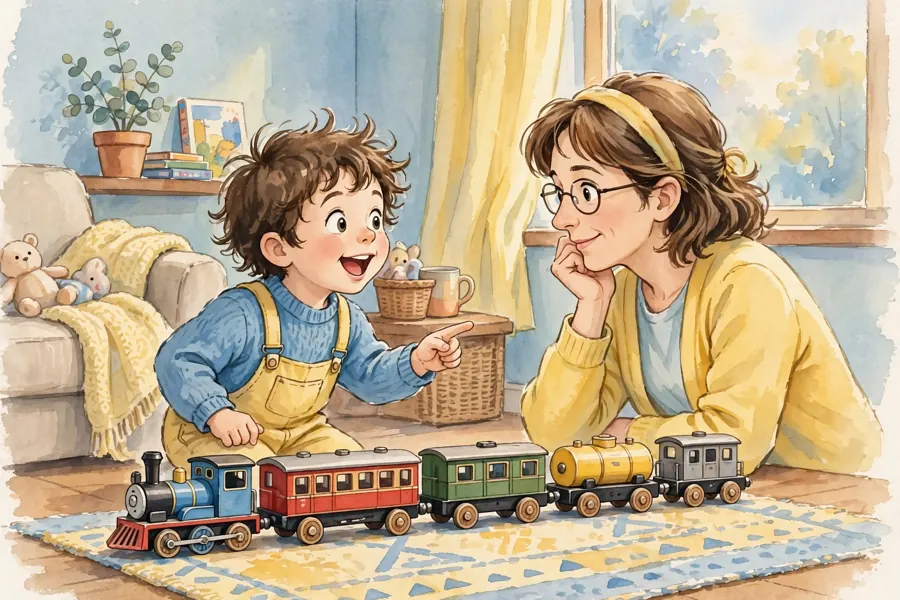
Many autistic children have deep, passionate interests — trains, dinosaurs, a favourite game, space, animals, a particular fictional world. These interests are sometimes talked about as if they were a problem to manage. In communication terms, they are better seen as a bridge: a child’s interest is where their motivation, knowledge and joy live, and conversation flows most easily there. Joining a child in their interest, asking genuine questions about it and letting them be the expert are some of the strongest ways to build connection, language and confidence — and they show the child that what matters to them matters to you.
How communication can look in ADHD
ADHD shapes how the brain manages attention, energy and impulses, and conversation is one of the places this shows up most. As with autism, every child with ADHD is an individual, and the patterns below are general. They are differences in how the brain works — never rudeness, defiance or bad behaviour — even though they are sometimes mistaken for those things.
Talking a lot, and talking quickly
Many children with ADHD are enthusiastic talkers. Thoughts arrive quickly and pile up, and talking is how they process them. A child might tell long, detailed stories, move rapidly between topics, or talk over the top of quieter moments simply because the thought feels urgent and they are afraid of losing it. This verbal energy often comes with real gifts — humour, storytelling, creativity and infectious enthusiasm.
Interrupting and turn-taking
Waiting for a gap in conversation requires holding a thought in mind while paying attention to someone else — a double task that an ADHD brain can find genuinely hard. A child may interrupt not because they do not care what the other person is saying, but because the thought will be gone if it is not said now, and because judging when a pause is really a pause is difficult when attention is flickering.
Losing the thread
Conversations and instructions place heavy demands on working memory — the brain’s notepad. A child with ADHD may lose the thread of a long story, forget the question they were just asked, drift during group discussion, or answer a different question from the one that was asked. Lengthy spoken instructions are especially easy to lose: the first step may be forgotten before the last one is heard.
Listening while moving
Many children with ADHD listen better when their bodies are busy. A child who fidgets, doodles, paces or fiddles with something while you talk may be concentrating harder, not less — movement helps their brain stay alert and regulated. Expecting stillness and eye contact as proof of listening can actually make listening harder for these children.
Attention differences in conversation
Attention in ADHD is not simply “low”: it is interest-driven. A child may focus intensely on a conversation about something they love and fade quickly from one that does not engage them. In conversation this can look like changing topics suddenly, missing social cues while absorbed in their own point, or needing the pace of interaction to stay lively to stay tuned in. Socially, the challenges are real — friendships can wobble when interrupting or drifting is misread by other children — but they respond well to understanding, structure and gentle, explicit coaching rather than criticism.
When autism and ADHD overlap
Autism and ADHD are different profiles, but they frequently travel together: a child can be both autistic and have ADHD. When they do, the two profiles interact in individual ways. A child might, for example, crave social connection and talk enthusiastically (an ADHD-flavoured trait) while finding the cues and unspoken rules of interaction hard to read (an autistic trait), or need routine and predictability while also finding it hard to sit through the routines themselves.
This overlap is one reason individual assessment matters so much. General descriptions — including this guide — can only sketch typical patterns. Each child’s communication profile is their own blend of strengths, differences and needs, and support that works for one child may not suit another, even with the same labels. Assessment for autism and ADHD themselves is carried out by the appropriate professionals, usually through health or education routes in your country. A speech and language therapy assessment sits alongside that: it does not diagnose autism or ADHD, but it maps how a child communicates — what they understand, how they express themselves, how they interact — and turns that map into practical support.
What matters most is not the label itself but what the label unlocks: understanding, adjustments, and support that fits the child in front of you.
Behaviour is communication
One of the most helpful ideas for families is this: behaviour is communication. Children — especially children who cannot yet say what they need in words, or whose words disappear under stress — use behaviour to send messages. A child who runs away from the classroom may be saying “this is too loud, too hard or too much”. A child who shouts, cries, goes quiet or refuses may be saying “I’m overwhelmed”, “I don’t understand”, “I need a break” or “something feels unfair and I have no words for it”.
This way of thinking changes the adult’s job. Instead of asking only “how do I stop this behaviour?”, it adds a kinder, more useful question: “what might my child be telling me?” That question does not mean every behaviour is simply allowed — boundaries still matter, and safety matters most of all. It means the response starts with understanding the message, because once the message is understood, you can teach a clearer way to send it: a word, a sign, a picture, a break card, or a phrase the child can reach for next time.
Behaviour-as-communication applies to autistic children and children with ADHD alike. The child with ADHD who calls out in class may be communicating “my thought will vanish if I wait”. The autistic child who covers their ears in a busy shop is communicating something real about their sensory experience. When the adults around a child share this understanding — at home and at school — children feel safer, and communication grows.
Supporting communication at home
You do not need special training or equipment to support your child’s social communication. The most effective support is woven into ordinary life, follows the child’s lead, and respects the way their brain works. Here are the approaches families and therapists return to again and again.
Follow your child’s lead and interests
Join the play or topic your child has chosen, rather than redirecting it. Sit alongside, show interest, comment rather than quiz, and let your child be the expert on the things they love. Following the lead builds trust and motivation — the foundations communication grows from — and gives you natural, relaxed material for conversation.
Use visual supports where they help
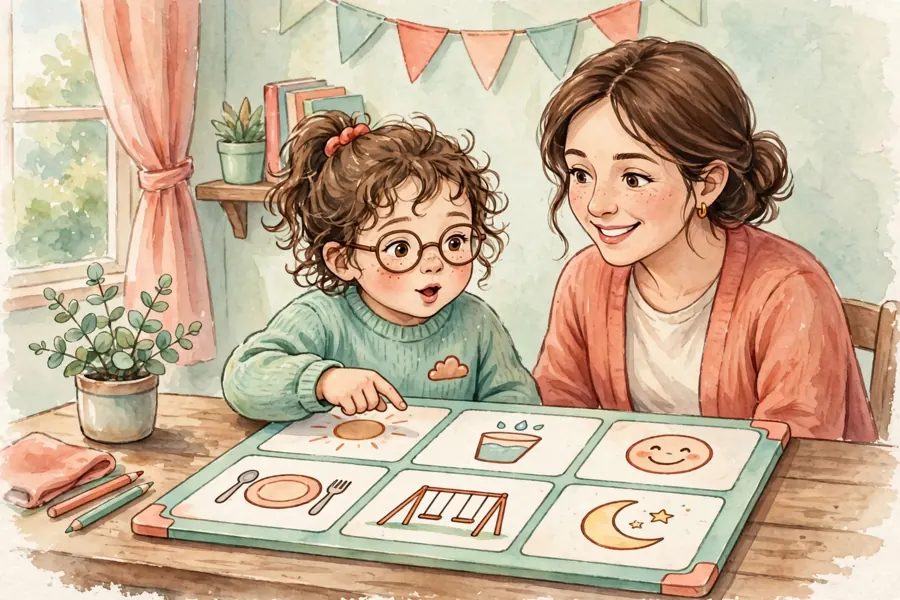
Many children understand what they can see more easily than what they can only hear, because spoken words vanish the moment they are said while pictures stay put. Visual supports — described by type, since the right choice is individual — include picture schedules that show what happens today, choice boards for offering options, social narratives that explain a coming event in simple words and pictures, and break cards a child can hand over when they need time out. Visual supports are not a step down from talking; they are scaffolding that helps understanding, independence and calm.
Keep routines predictable
Knowing what happens next lowers anxiety and frees up energy for communication. Predictable daily routines — and gentle preparation before changes, such as a visual schedule, a countdown or a simple explanation of what will be different — help many autistic children and children with ADHD feel secure enough to interact and join in.
Give processing time
Words take time to land, especially when a child is also managing noise, movement or strong feelings. Ask once, then wait — a proper, unhurried pause — before repeating or rephrasing. Rushing in with the same question again, or a stream of new ones, can restart the thinking your child was already doing. Slow, calm, one-idea-at-a-time talk is easier to take in.
Model without pressure
Children learn conversation by being in conversation. Model the language and social moves you hope to build — greeting, commenting, asking, repairing misunderstandings — in natural ways, without demanding your child copy you on the spot. Comment more than you question: “That tower is enormous” invites talk, while a string of test questions (“What’s this? What colour is that?”) can make conversation feel like an exam.
Celebrate every form of communication
A point, a glance, a sign, a picture handed over, a repeated phrase, a full sentence — treat every attempt as the real communication it is, and respond to the message first. Children communicate more when communicating works: when their messages are noticed, understood and answered. Nothing builds communication like the experience of being heard.
Social communication at a glance
The table below sums up some everyday areas of social communication, what you might notice, and what tends to help. It is a starting point for understanding, not a checklist for judging your child.
| Area of communication | What you might notice | What can help |
|---|---|---|
| Starting conversations | Finds it hard to join in, or dives in without an opening | Practise simple openers; use shared interests as the starting point |
| Turn-taking | Interrupts, talks over others, or rarely takes a turn | Slowing the pace, visual turn markers in games, gentle and explicit practice |
| Reading cues | Misses hints that someone is bored, upset or joking | Name cues kindly and out loud: “She’s frowning — she might be worried” |
| Non-literal language | Takes idioms, teasing or sarcasm literally | Explain sayings and jokes directly; check understanding without teasing |
| Keeping a topic going | Loses the thread, changes topic suddenly, or stays on one topic at length | Short exchanges, visual reminders of the topic, joining the child’s topic first |
| Communicating needs | Uses behaviour, sounds or actions instead of words | Offer words, signs, pictures or a break card as easier ways to send the same message |
Communication at school
School is an intensely social place, and social communication demands run all day: listening in a group, working with partners, navigating the playground, understanding teachers’ indirect requests (“I think some people are still talking” means “please be quiet”) and coping with change. Children whose social communication works differently may manage the lessons themselves well while finding the social layer exhausting — or the reverse.
Families can help by sharing what works. With your consent, strategies that help at home — visual schedules, processing time, a quiet space, movement breaks, warning before changes — can be shared with teachers so your child meets the same understanding in both places. If your child has had a speech and language therapy assessment, the recommendations from it can, again with your consent, inform the school’s support. Many schools can also arrange their own observations or involve their own linked professionals; asking the teacher what the school’s route is makes a good first step. What matters is that home and school pull in the same direction, and that your child hears the same message in both places: you are understood, and communication — in whatever form — is welcome here.
How speech and language therapy can help
A speech and language therapist who works with autistic children and children with ADHD begins with the whole communication profile, not just spoken words. An assessment usually involves talking with you about your child’s development and daily life, observing and playing with your child, and looking at how they understand language, express themselves, interact and use every form of communication available to them. Hearing is often considered too, since children communicate best when they can hear clearly.
From that picture, goals are built with you — practical goals that matter in your child’s real life, such as joining play more comfortably, making needs known safely, understanding classroom talk, or widening the ways a child can communicate. Therapy might involve working directly with your child through play and their interests, coaching the adults around them in helpful strategies, and introducing AAC where it would help a child communicate more fully right now. Sessions are shaped around the individual child: their pace, their sensory needs, their motivations. Progress looks different for every child and happens at different speeds, and honest support focuses on functional communication — messages getting across, frustration easing, connection growing — rather than on making a child communicate in one “right” way.
When to seek help
Differences in social communication are part of who many children are, and difference alone does not mean something is wrong. Still, there are times when asking for professional advice is a sensible, supportive step. You know your child well — trust what you see. It is worth seeking advice if:
- Your child seems frustrated, upset or withdrawn when trying to communicate, or appears to have stopped trying.
- Your child has few reliable ways to make their needs and wishes known, and daily life is full of guesswork and frustration as a result.
- Understanding everyday language, instructions or questions seems hard for your child compared with children around them.
- Social communication difficulties are affecting play, friendships, family life or learning.
- Your child loses skills they once had — words, sounds or ways of interacting that they used before disappear. Losing skills at any age deserves prompt professional advice.
- You simply feel worried or unsure. Asking for advice is a reasonable step, even if the outcome is reassurance and ideas.
The usual route is to talk to your child’s doctor or another health professional, or to your child’s teacher, who can point you towards the right assessment pathways. You can also contact a speech and language therapist directly about your child’s communication; formal assessment and identification of autism or ADHD, where a family wishes to explore it, is carried out by the appropriate professionals through the routes in your country.
One situation is different, and urgent. If a child suddenly loses speech, or their speech suddenly becomes slurred or very hard to understand, or you notice a sudden change in their face or strength, treat this as an emergency and call your local emergency number straight away. Sudden changes like these need urgent medical help.
For general information, you can also visit the World Health Organization and the American Speech-Language-Hearing Association (ASHA), or follow the guidance of your own national health authority.
Questions to ask a therapist
If you arrange an assessment or a first appointment, these questions can help you get the most from it:
- What will the assessment involve, and is there anything we should bring or prepare?
- What are my child’s communication strengths, and which areas would support help most?
- How do you see behaviour and communication linking together for my child?
- Would visual supports or AAC help my child, and how would we introduce them at home?
- What can we do at home, within our everyday routines, to support our child’s communication?
- How can nursery or school be involved, and what would you share with them?
- How will goals be agreed, and how will we review progress together?
Frequently asked questions
Is social communication difficulty the same as having few words?
No. Social communication is about how language is used to connect — turn-taking, cues, topics, jokes and feelings. A child can have a large vocabulary and long sentences and still find the social layer of conversation hard. Another child may use very few words but communicate warmly and effectively through gestures, pictures or behaviour. The two need to be looked at separately, which is what an assessment does.
My child repeats lines from favourite shows. Should I stop this?
Repeating memorised lines — a form of echolalia — is a genuine way of communicating for many children, and often a step in how they build their own sentences. Rather than stopping it, try listening for the message inside the line: the same words often mean something specific in context, such as a request, a protest or a comment. Responding to that message shows your child their communication works.
Will using picture boards or signing stop my child from talking?
No. Picture supports, communication books, signing and speech-generating tools sit alongside speech rather than replacing it. They give a child a way to communicate right now, which usually reduces frustration and can actually encourage talking, because the pressure is off and messages keep flowing. Communication in any form is a foundation to build on, not a barrier to speech.
My child talks constantly but conversations still feel one-sided. Why?
Some children — including many children with ADHD and many autistic children — find the back-and-forth of conversation harder than the talking itself. Holding another person’s topic in mind, noticing cues that a listener wants a turn, and judging how much detail to give are all demanding skills. It is not selfishness or rudeness; it is how their brain handles interaction. Slower pacing, shared interests and gentle, explicit practice with turn-taking all help.
Can a child be both autistic and have ADHD?
Yes. Autism and ADHD can and do occur in the same child, and when they do, the child’s communication profile reflects their own blend of both. This is one reason individual assessment matters: support should fit the child in front of you, not a general picture of either profile alone.
What is the first step if I am worried about my child’s social communication?
Talk to your child’s doctor, another health professional or their teacher about what you have noticed, and ask about a speech and language therapy assessment. You can also contact a speech and language therapist directly. An assessment gives you a clearer picture of your child’s strengths and needs and practical ideas for home — asking does not commit you to anything.
Related guides
- How to support a non-speaking child
- AAC communication boards for children
- Support for children and parents: the For Kids and Parents hub
- Speech and language therapy services for children
- Browse all conditions and topics
A gentle next step
Every child’s way of communicating deserves to be understood, and you do not have to work out the best way to support your child alone. If you would like to talk about your child’s communication — what you have noticed, what you are unsure about, and what might help — you are very welcome to get in touch online. There is no obligation and no pressure: just a friendly first conversation, at your pace.
By Hamayal Adnan, Speech-Language Pathologist
This article is for general educational purposes only and is not medical advice. It does not replace an assessment by a qualified speech and language therapist or other healthcare professional. Every person is different. If you have concerns about speech, language, feeding or swallowing, please seek professional advice. In an emergency, call your local emergency number.