
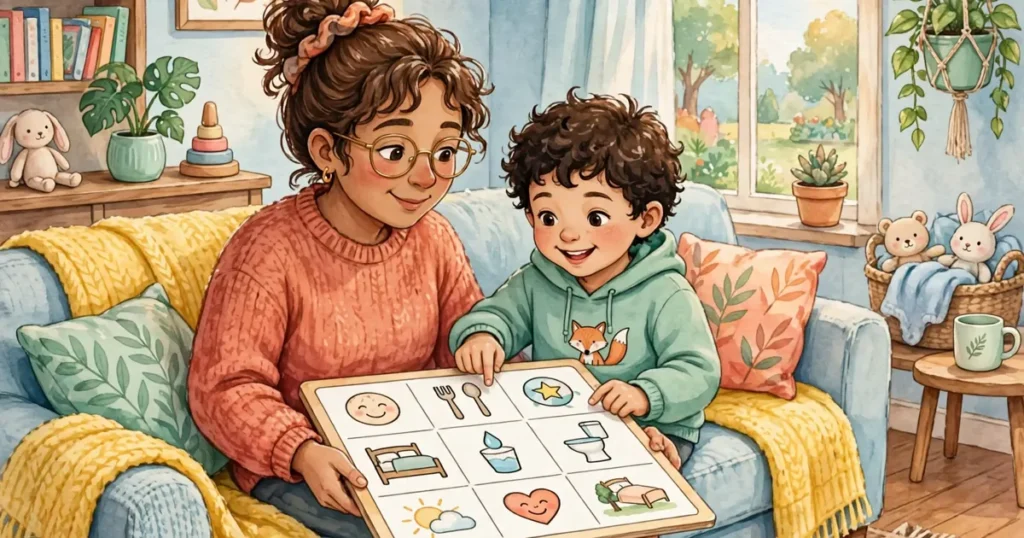
Communication is much more than speech. A non-speaking child is still communicating — through gestures, expressions, sounds, pictures and behaviour — and support means giving them more ways to share their messages while presuming they understand and have plenty to say. Responding to every form of communication, and offering tools such as AAC (augmentative and alternative communication), grows that child’s world of connection.
If your child uses few spoken words, or none at all, you may wonder whether other people see the child you know: funny, thoughtful, full of preferences and opinions. This article is about helping that child be heard, at home and at school.
Key Takeaways
- A non-speaking child is communicating already. Support starts with noticing and responding to how they communicate now.
- Presume competence: assume your child understands more than they can show, talk to them directly, and use respectful, age-appropriate language.
- AAC — picture boards and books, signing, and voice-output technology — gives children more ways to communicate, and does not hold speech back.
- Modelling matters: when adults use the child’s communication system themselves, without pressure, children learn how it works.
On this page
- What does “non-speaking” mean?
- Start by presuming competence
- The many ways children communicate
- AAC: more ways to communicate
- Modelling AAC: showing, not testing
- Building communication into everyday routines
- Supporting your child at school
- Friendships and inclusion
- When communication feels hard
- What speech and language therapy support can involve
- When to seek help
- Questions to ask a therapist
- Frequently asked questions
- Related guides
What does “non-speaking” mean?
“Non-speaking” is a descriptive term. It describes how a child communicates most of their messages: not through spoken words, or through only a few of them. It says nothing about what a child understands, thinks or feels.
Children described as non-speaking are not all the same:
- Some use no spoken words at all.
- Some use a small number of words or word approximations that familiar people understand.
- Some speak in some situations — perhaps a word here and there at home — but not reliably, and not for everything they want to say.
- Some children’s speech comes and goes: tiredness, stress or unfamiliar places can make words harder to find.
Many families and professionals prefer “non-speaking” to the older term “non-verbal”. “Non-verbal” can sound as if a child has no language at all, and that is not the case: a non-speaking child may understand a great deal, and communicate richly in other ways. The words are not missing — they are travelling by a different route than speech.
“Non-speaking” also describes the present, not a fixed future. Children’s communication changes and grows over time, at its own pace. Whatever route it takes, the goal of support is the same: more connection, more choice, and more chances to be understood.
Start by presuming competence
Presuming competence means starting from the belief that your child understands more than they can currently show, and that they have thoughts, feelings and preferences worth hearing.
- Talk to your child, not about them. Include them in conversations around them: say good morning, explain what is happening next, tell them the joke too. Discuss them with other adults kindly, and never as if they were not in the room.
- Use age-respectful language. Speak to a seven-year-old as a seven-year-old, even if their communication sounds much younger. Simple, clear sentences are fine; babyish talk is not needed.
- Assume understanding, and check kindly. A child who cannot answer a question may still have understood it. Watch for small signs — a glance, a movement, a change in expression — and give time for them.
- Keep expectations open. Nobody knows in advance how a child’s communication will develop. Presuming competence keeps doors open rather than deciding in advance what a child can and cannot do.

The many ways children communicate
Noticing the ways a non-speaking child communicates every day is the first half of support; responding to them is the second.
- Gestures and movement. Reaching, pointing, waving, nodding, shaking the head, pushing something away, or taking an adult’s hand and leading them to what they want. Leading by hand is a clear message: “come and see this.”
- Facial expression and eye gaze. Smiles, frowns, looking towards something interesting, looking away when it is too much. A glance held a moment longer can be a request, a comment or a greeting.
- Sounds. Laughing, humming, squealing with delight, crying, or a particular sound that familiar people learn to recognise.
- Behaviour. Moving towards or away from something, becoming restless, covering ears, leaving the room, or becoming upset — often a message about feelings and needs.
- Pictures and symbols. Pointing to a picture of a drink, an activity or a feeling to ask, choose or comment.
- Signing. Using hand signs, either a full sign language or a set of key signs alongside everyday life.
- Technology. Devices and apps that speak a message aloud when a child selects words or pictures.
Every one of these is real communication, and every response teaches the child that their messages work.
AAC: more ways to communicate
AAC stands for augmentative and alternative communication: all the tools and strategies that support or replace spoken language:
- No-tech AAC. Gestures, facial expressions and signing need no equipment at all, and are available everywhere — including the bath and the swimming pool.
- Low-tech AAC. Picture communication boards and communication books hold pictures or symbols a child can point to; there are also letter boards for children who can spell. They are simple to make and never run out of battery.
- High-tech AAC. Voice-output devices and tablet-based apps speak a selected message aloud. A child might tap pictures to build a sentence, or select a ready-made phrase.
A few reassuring points:
- There is no “ready or not ready”. A child does not need to prove skills first, or use simple tools before being offered richer ones. Support can start at any point.
- More options, not fewer. AAC adds routes to communicate; it does not take speech away. A child can use pictures for one message, a sign for another, and a word for a third.
- The system should fit the child. The best system is shaped around the child’s abilities, interests and daily life, and grows with them.
Modelling AAC: showing, not testing
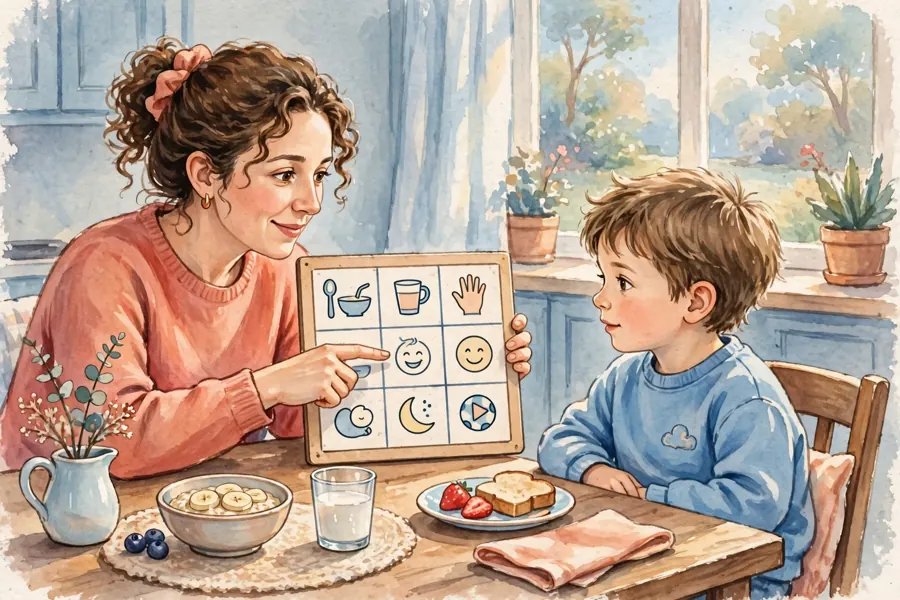
Children learn spoken language by hearing it used around them, long before they say words themselves. AAC works the same way. Modelling means the people around a child use the child’s communication system themselves, in real moments, so the child sees how it works: pointing to “cereal” and “more” on the board at breakfast as you say the words aloud, for example.
- No demands. You are showing, not testing. Your child does not have to copy you, answer, or perform. If they join in, lovely; if they watch, that is learning too.
- Model the words that matter. Choices, comments, greetings, jokes, protests and feelings — not only requests for food and toys. Children have far more to say than “I want”.
Building communication into everyday routines
Communication grows in ordinary moments: the routines you already have are full of chances to connect.
- Offer choices all day long. Two cereals, the red cup or the blue one, this song or that one. Hold the options up, name them, point to the pictures if you use them, and honour the answer — including a glance or a reach. Real choices teach a child that communicating changes what happens.
- Wait. After you ask or show something, pause and look expectant. Children who communicate without speech often need more time to organise a response — a movement, a look, a point. Waiting quietly, without repeating the question, protects that time.
- Watch for tiny signals. A stilling, a breath, a small sound, a shift of the eyes: these may be the beginnings of a message. Responding to them — “I saw that. You want more.” — tells your child their quietest attempts count.
- Respond to every attempt. Whatever form a message takes, answer it as a message. If you are unsure what it means, say so warmly and take your best guess: “I think you’re telling me this is too loud. Let’s move somewhere quieter.”
Supporting your child at school
Home and school are the two big worlds of a child’s life, and support works best when they talk to each other:
- Share what works. Tell school how your child communicates: their gestures, signs, sounds and systems, what their signals mean, and what helps when things are hard. A simple written profile — sometimes called a communication passport — helps every adult have the same information.
- Keep systems consistent. The same system, with the same pictures and words in the same places, at home and at school makes learning it far easier.
- Keep the system within reach. A communication aid only works if the child can get to it. It should travel with your child — classroom, playground, lunch hall — and come home again. A board left in a drawer teaches a child that their words are not always available.
- Support the communication partners. Teachers, assistants and classmates may need a little training: how to model on the system, how long to wait, how to ask questions the child can answer with it. A speech and language therapist can often help with this.
Friendships and inclusion
Friends matter to every child, and a child who communicates without speech has the same wish to belong, join in and be chosen.
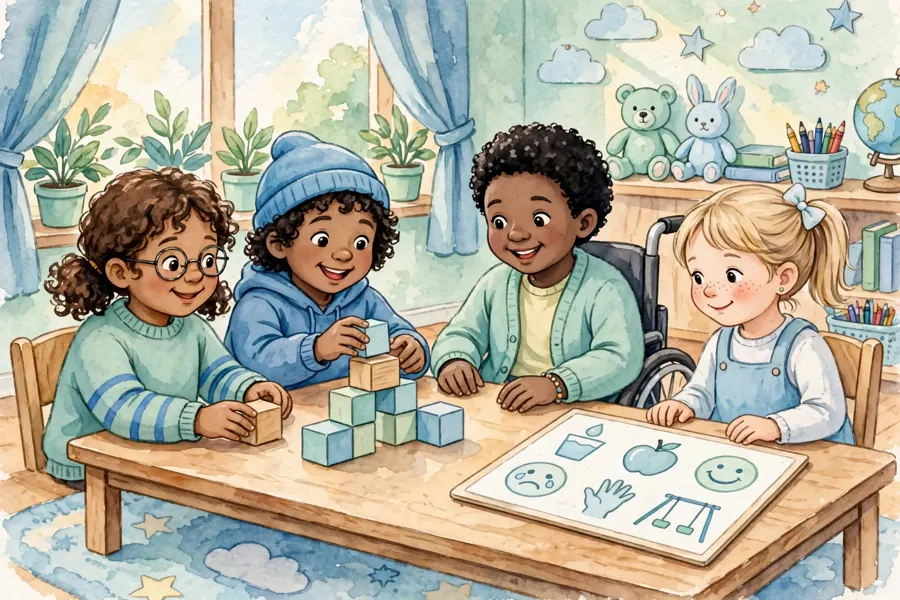
- Teach peers simple ways to connect. Classmates are often keen but unsure. Showing them how your child says yes and no, how to offer a choice, how to wait for an answer, and how the system works turns uncertainty into confidence.
- Build on shared interests. Friendships grow around doing things together: the same games, songs, jokes or books. Arrange play around what your child genuinely enjoys.
- Make group life accessible. Circle time and class discussions move fast. Visual supports, extra time, and ways to answer other than putting a hand up and speaking help a non-speaking child take part as an equal.
When communication feels hard
Even with good support, there will be hard moments. A child who cannot yet say “I don’t understand”, “this is too much” or “I need a break” may show it instead: becoming upset, refusing, running away, shutting down or melting down. This is often described as behaviour as communication — the behaviour carries a message the child cannot yet send another way.
- Look for the message first. Ask what your child might be telling you: too loud, too fast, unexpected change, pain, tiredness, hunger, confusion.
- Stay calm and keep language simple. In a hard moment, fewer words, spoken gently, are easier to take in. Offer the communication system if your child can use it then — and accept that sometimes they cannot, and comfort comes first.
- Notice the patterns afterwards. Jotting down what happened beforehand can reveal patterns over time — each one a chance to adjust something, or to teach a new way to send that message, such as a picture for “break” or “help”. Above all, be patient: learning new ways to communicate takes time, and hard days are not failures.
What speech and language therapy support can involve
A speech and language therapist supports the whole of a child’s communication, not only speech, and might help with:
- Getting to know your child’s communication. Observing how your child communicates now, what they understand, how they play and interact, and exploring which AAC tools might suit them.
- Coaching the people around the child. Much of therapy works through communication partners — showing families and school staff how to model, wait and respond.
- Setting goals that matter. Goals are usually functional — things that make a real difference, like choosing, refusing, asking for help or joining in — and support is reviewed and adjusted with you as your child changes.
When to seek help
You know your child best, and if you are concerned about their communication, asking for advice is always a reasonable step. It is particularly worth seeking support if:
- Your child has very few ways to communicate, and everyday life often feels frustrating.
- Your child seems to understand much less than other children of a similar age, as well as not speaking.
- Your child’s communication does not seem to be moving forward over time.
- You would like help exploring AAC, or your child’s current system no longer seems to meet their needs.
- You simply feel worried, or unsure what to do next. You do not need to be certain before asking.
One pattern deserves prompt advice at any age: losing skills. If your child stops using words, signs, gestures or ways of communicating they had before, seek professional advice promptly.
One situation is an emergency. If a child suddenly loses speech or other skills, their face suddenly droops on one side, they have sudden weakness, or they are choking or having difficulty breathing, call your local emergency number immediately.
The usual first step is to talk to your child’s doctor or another health professional, or to their teacher, who can point you towards a speech and language therapy assessment. In many places you can also contact a speech and language therapist directly. For general information, visit the World Health Organization and the American Speech-Language-Hearing Association (ASHA).
Questions to ask a therapist
These questions can help you feel prepared for an assessment or first appointment:
- How does my child communicate at the moment, and what are their communication strengths?
- Which AAC tools or systems might suit my child, and how would we introduce them?
- How can the adults in our child’s life learn to model and support the system well?
- What communication goals would you suggest first, and how will we review them together?
- How can home and school keep my child’s communication support consistent?
Frequently asked questions
Will AAC stop speech from developing?
No. AAC supports communication, and it does not hold speech back. A child who uses pictures, signs or a voice-output device has more ways to get their message across, not fewer, and spoken words can continue to develop alongside AAC. For some children, having the pressure taken off seems to help speech come in its own time. For others, AAC becomes their main and lasting way to communicate, which is equally valuable.
Does my child need to show certain skills before starting AAC?
No. There are no entry requirements for communication, and a child does not need to point reliably, match pictures or sit still first. The skills grow by using the system, with modelling and support — just as talking grows by being talked to.
How do I know what my child is trying to tell me?
Start with what you already know: your child’s routines, likes, dislikes and signals. Familiar people are often skilled at reading small cues — a look, a sound, a movement. When you are unsure, offer your best guess out loud and watch the reaction: “I think you want the music on. Yes? Let’s try.”
What if family members are unsure about AAC?
This is common, and it usually comes from care — often a worry that AAC means giving up on speech. Explaining that AAC adds ways to communicate rather than replacing speech — and that everyone keeps talking to the child as usual — often helps. Seeing the system in action can turn doubt into enthusiasm.
How can I help classmates understand my child’s communication?
Children are usually accepting when things are explained simply. With the school’s agreement, a teacher can introduce how your child communicates, show classmates how to offer choices and wait for answers, and let them see the system being used. The message is simple: your child has plenty to say, and this is how they say it.
Should we use just one communication system?
Most children do best with a mixture that suits the moment: signs are handy in the pool, a board works at the table, a device may be best for longer messages. One main system, used consistently in the same layout, usually sits at the centre. What matters most is that a reliable way to communicate is available in every situation.
Related guides
- Autism, ADHD and social communication: a complete guide
- AAC communication boards for children
- Support for children and parents: the For Kids and Parents hub
- Speech and language therapy services for children
- Browse all conditions and topics
A gentle next step
Supporting a non-speaking child is about listening in more ways, and making sure your child has the tools to be heard in more places. If you would like to talk about your child’s communication — the ways they connect now, and what might help next — you are very welcome to get in touch online. There is no obligation and no pressure: just a friendly first conversation, at your pace.
By Hamayal Adnan, Speech-Language Pathologist
This article is for general educational purposes only and is not medical advice. It does not replace an assessment by a qualified speech and language therapist or other healthcare professional. Every person is different. If you have concerns about speech, language, feeding or swallowing, please seek professional advice. In an emergency, call your local emergency number.