

Babbling is the playful stream of sounds babies make as they learn to use their voice, lips and tongue — from early cooing to chains of syllables like “ba-ba-ba” and, later, tuneful babble that sounds almost like talking. It matters because it is a baby’s first practice at speech and at conversation: babies babble to connect with you, to explore sounds, and to build the skills that first words will grow from. Every baby follows their own path, and babbling develops in broad, overlapping stages rather than to a fixed timetable.
If you have ever found yourself answering your baby’s “ah-goo” as if it were a real conversation, you were already taking part in something important. This page explains what babbling is, the broad stages most babies move through, why it matters, and simple ways to encourage it in everyday life. It also explains when it is worth checking hearing or asking for advice. It cannot say how your own baby is developing — only an assessment can look at the whole picture — but it can help you enjoy this stage and know what to watch for.
Key Takeaways
- Babbling is how babies practise the sounds, rhythms and turn-taking that talking is built on.
- It develops in broad stages: cooing, early babble, repeated-syllable babble, then tuneful “jargon” that sounds like conversation.
- These stages overlap, and babies move through them at different rates — there is no single day a stage should appear.
- Babies babble most when people respond, so chatting back is one of the best ways to encourage it.
- Hearing is closely linked to babbling, so a baby who is very quiet, or who does not respond to sounds, is worth discussing with a professional.
- If you are worried about your baby’s sounds, listening or responses, asking for advice is always a reasonable step.
On this page
- What babbling is
- The broad stages of babbling
- Why babbling matters
- How to encourage babbling in everyday moments
- Quieter babies and babbling
- When to seek help
- Questions to ask a therapist
- Frequently asked questions
- Related guides
What babbling is
Babbling is the sound-making play of the first year of life. Long before babies can say words, they experiment with their voices: squealing, growling, blowing raspberries, and stringing sounds together. It may sound random, but it is purposeful practice — a baby is learning how their mouth, tongue, lips and breath work together to make sounds on purpose.
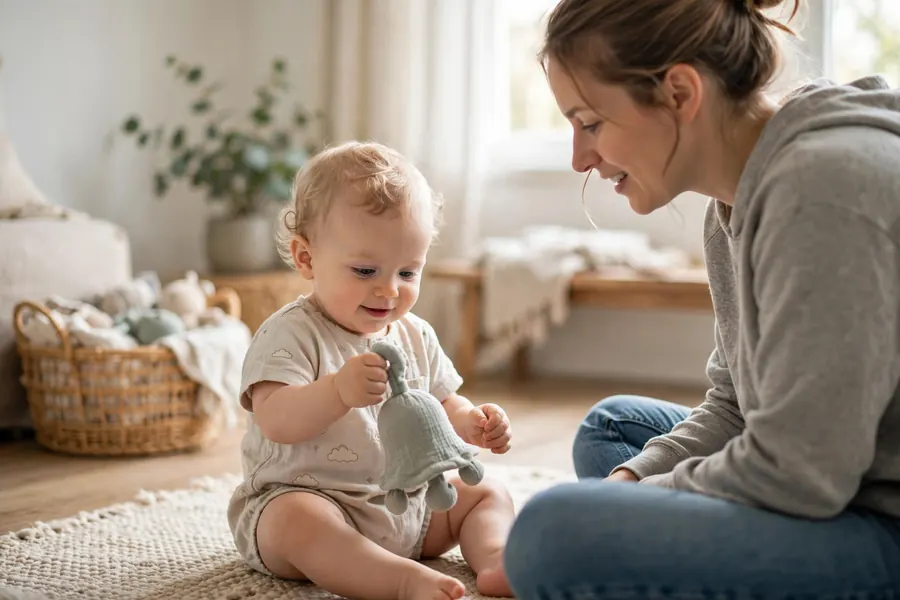
Babbling is different from crying. Crying is a baby’s way of signalling a need — hunger, tiredness, discomfort. Babbling usually happens when a baby is content and comfortable: lying on a mat, watching your face, or playing with a toy. It is often social, too. Many babies babble more when someone is looking at them, listening and responding.
It helps to think of babbling as two things growing at once. The first is sound play: the physical skill of producing and combining sounds. The second is communication: the discovery that sounds get a reaction, that a noise from me brings a smile, a reply or a cuddle from you. Both matter, and both come before first words.
The broad stages of babbling
Most babies move through a recognisable sequence of sound-making stages. These stages are broad patterns, not milestones with deadlines. They overlap, they arrive in their own time, and a baby may seem to race through one stage and linger in another. Premature babies and babies who have been unwell may follow the same pattern on a different timescale, which is one more reason to look at the whole picture rather than a calendar.
Cooing and early sounds
Early on, a baby’s sounds are mostly cries, along with small contented noises — sighs, grunts and soft vowel-like sounds such as “ooh” and “ah”. Over the first months, these gentle sounds often grow into cooing: soft, musical, vowel-like sounds a baby makes when comfortable and engaged, often while gazing at a familiar face. Laughter joins in somewhere along the way, and with it more playful sounds — squeals, shrieks and raspberries as your baby discovers what their voice can do.
Early babble
As babies gain more control of their mouths, consonant-like sounds begin to appear among the vowels — sounds made with the lips and the back of the mouth, like “p”, “b”, “m” and “g”. Parents often hear these in happy strings like “goo” or “aga”. This early babble is still mostly sound play, but the building blocks of speech sounds are starting to appear.
Canonical babble: repeated syllables
A step that professionals take real notice of is canonical babbling — well-formed syllables repeated in chains, like “ba-ba-ba”, “da-da-da” or “ma-ma-ma”. These sound strikingly like real speech, which is why “dada” at this stage is usually a happy coincidence rather than a first word. What matters is the pattern itself: your baby can now produce clear syllables and repeat them, a key step on the road to words. Babies also begin to vary these chains — mixing sounds into longer, more varied strings.
Jargon: babble that sounds like talking
Later in the first year, many babies produce what is often called jargon: long, tuneful streams of babble with the rises, falls and pauses of real sentences, but without recognisable words. It can sound uncannily like your baby is holding forth in a language of their own, sometimes complete with gestures and meaningful looks. Jargon is a good sign that a baby is absorbing the music of the language around them — the rhythm and melody that words will later slot into.
These stages describe a common path, not a checklist. Some babies are prolific babblers; others are quieter observers who vocalise less but listen intently. What professionals look at is the overall direction: sounds generally becoming more varied, more speech-like and more social over time.
Why babbling matters
Babbling can look like simple play — and it is play — but it is doing several important jobs at once.
Practice for speech
Every squeal, raspberry and syllable chain is exercise for the voice, lips, jaw and tongue. Babies who babble are rehearsing the mouth movements and sound combinations that speech needs. Repeated-syllable babble, in particular, uses the same kind of rhythmic jaw and lip movements as early words, so the step from “ba-ba-ba” to a first real word is smaller than it sounds.
The start of back-and-forth communication
Babbling is where conversation begins. Your baby makes a sound; you respond; your baby listens, then answers with another sound. These early exchanges teach the rhythm of talking — my turn, your turn — long before words arrive. Babies whose babble is answered tend to babble more, and the back-and-forth itself becomes a game both of you enjoy. This turn-taking is the foundation that all later conversation is built on.
A window into hearing
Babies shape their sounds based on what they hear — both the voices around them and the sound of their own voice. Babbling that develops and varies over time is one of the everyday signs that a baby is hearing speech and learning from it. That is why professionals are interested in babbling: a baby who babbles very little, whose babble does not seem to change, or who does not respond to sounds around them may need their hearing checked, because hearing clearly is essential for learning to talk. Our guide to the signs of speech delay in toddlers explains more about hearing-related signs in young children.

How to encourage babbling in everyday moments
You do not need special equipment, lessons or set activities to support babbling. Babies learn to communicate in ordinary moments with the people they love, and the most powerful tool you have is simply responding. These ideas are general information, not a treatment programme — they are gentle ways to give your baby rich chances to practise sounds.
- Get face to face. Babies babble most when they can see your face. Time on a mat, in your arms or across a changing table, where your baby can watch your mouth and eyes, invites sound-making.
- Answer your baby’s sounds. When your baby coos or babbles, reply as if it were your turn in a conversation — with words, with a smile, or by copying their sound back. Copying is powerful: it tells your baby their sounds are interesting and worth repeating.
- Pause and wait. After you speak or copy a sound, pause and look expectantly. Babies need time to organise a reply, and the pause is their invitation to take another turn.
- Talk through the day. Narrate what you are doing in short, simple phrases — “we’re putting your socks on” — especially during feeding, dressing, bath time and play. Your baby is soaking up the sounds and rhythms of your language.
- Sing songs and rhymes. Nursery rhymes, action songs and simple repeated tunes are full of the predictable patterns babies love. Pausing before a favourite word or action gives your baby a chance to join in with a sound, a wiggle or a smile.
- Play sound games. Peekaboo, tickle games and toys that rattle, squeak or crinkle all create moments worth vocalising about. Follow your baby’s lead — babble tends to flow when a baby is interested and enjoying themselves.
- Keep background noise down sometimes. A television or radio playing constantly can mask the sounds of voices. Quiet moments make it easier for your baby to hear you — and to hear themselves.
- Enjoy it. Above all, treat babbling as a conversation you both enjoy, not an exercise. A relaxed, responsive atmosphere is exactly the soil early communication grows in.
Little and often, woven into normal family life, is the pattern that helps. There is no need to set aside special “practice” time with a baby — the everyday moments you already share are the practice.
Quieter babies and babbling
Not all babies are chatterboxes, and a quieter baby is not automatically a cause for concern. Temperament plays a part: some babies are watchers, taking everything in before they join in noisily. Babies also babble less when they are tired, hungry, teething or unwell, and a busy period of physical development — learning to roll, sit or crawl — can temporarily take centre stage while sound play dips.
What is worth paying attention to is the overall pattern over time:
- Is your baby making some sounds, and are those sounds slowly becoming more varied?
- Does your baby respond to your voice and to everyday sounds — turning, stilling, smiling or looking?
- Does your baby enjoy back-and-forth moments, even quiet ones — looks, smiles, copied sounds?
- Has your baby stopped making sounds they used to make, or become noticeably quieter?
A baby who vocalises happily but less often than a friend’s baby may simply be developing in their own way. A baby who rarely makes sounds, whose babble does not seem to change over a long stretch, who does not respond to sounds, or who loses sounds they had, deserves a professional look — starting with hearing, because a baby who is not hearing clearly cannot be expected to copy sounds and words. Glue ear and other temporary hearing dips can affect young children, often without obvious signs of ear trouble, so a hearing check is a sensible and simple first step.
If your baby was born early, was unwell at birth, or has a condition that affects development, your health team will usually already be watching communication as part of wider care — do raise any sound or babbling questions with them as they arise.

When to seek help
Babbling develops at different rates, and only a professional who can look at the whole picture — sounds, hearing, understanding, play and interaction — can say how your own baby is doing. It is worth seeking advice if:
- Your baby makes very few sounds, or seems quieter rather than more vocal over time.
- Your baby’s sounds are not becoming more varied or more speech-like over the months.
- You have not noticed repeated-syllable babble (“ba-ba-ba”, “da-da-da”) as the first year unfolds.
- Your baby does not seem to respond to your voice or to everyday sounds, or responds inconsistently.
- Your baby loses sounds or ways of interacting they had before — this deserves prompt advice at any stage.
- Your baby seems frustrated when trying to communicate, or less interested in back-and-forth interaction.
- You simply feel worried. You do not need to be certain, or to wait for a particular stage, before asking.
The usual first step is to talk to your baby’s doctor or health visitor, and to ask about a hearing check as well as speech and language therapy advice. You can also contact a speech and language therapist directly in many areas. For general information, visit the World Health Organization and the American Speech-Language-Hearing Association (ASHA), or follow your national health authority’s guidance.
One situation is an emergency, and it applies at any age. If a baby, child or adult suddenly has difficulty breathing, is choking and cannot clear it, or if someone suddenly loses speech, their face droops on one side, or they have sudden weakness, call your local emergency number immediately.
Questions to ask a therapist
If you arrange an assessment or a first appointment about your baby’s communication, these questions can help you feel prepared:
- What will the assessment involve for a baby of this age, and is there anything we should bring?
- What have you noticed about my baby’s sounds, listening and interaction so far?
- Should my baby’s hearing be checked, and how do we arrange that?
- What can we do at home, within our everyday routines, to encourage sounds and turn-taking?
- What changes should we watch for over the coming months, and when should we seek advice again?
Frequently asked questions
When do babies usually start babbling?
Babies move towards babbling gradually: soft cooing sounds come first, then early babble with consonant sounds mixed in, then repeated-syllable babble, and then tuneful jargon. The timing varies a good deal from baby to baby, and the stages overlap, so there is no single age by which babbling “should” start. The overall direction — sounds becoming more varied and more speech-like over the first year — matters more than a date.
Is “dada” during babbling a real first word?
Usually not at first. When babies repeat syllables like “da-da-da”, they are practising sounds, and the fact that a chain sounds like “dada” or “mama” is often a happy coincidence. A first word is different: it is used deliberately, consistently and for a particular person or thing. Enjoy the coincidence either way — real words grow out of exactly this kind of practice.
My baby is quiet and does not babble much. Should I worry?
A quieter baby is not automatically a concern — temperament, tiredness and busy periods of physical development all play a part. It is worth asking for advice if your baby makes very few sounds over time, if their sounds are not becoming more varied, if they do not respond to voices and everyday sounds, or if they stop making sounds they used to make. Asking early gives you information; it does not commit you to anything.
Can hearing problems affect babbling?
Yes. Babies learn sounds by hearing them — both other people’s voices and their own. A baby whose hearing is reduced, for example because of fluid behind the eardrum, may babble less or their babbling may not develop in the usual way. This is one reason professionals often suggest a hearing check when a baby or young child’s sounds and talking seem delayed.
Does babbling in a bilingual home sound different?
Babies growing up with two or more languages babble just as other babies do, drawing on the sounds they hear around them. Hearing more than one language does not cause difficulties with babbling or talking, and you should keep chatting, singing and playing in whichever language feels most natural to you.
Should I correct my baby’s babble or teach sounds directly?
No correction is needed. The best response to babble is a friendly one: copy it, answer it, smile and take your turn. Babies learn sounds through play and interaction, not through drills or being told to “say it properly”. If you are concerned about how your baby’s sounds are developing, a speech and language therapist can look at the whole picture and advise you.
Related guides
- Child speech and language development: a complete guide for parents
- Signs of speech delay in toddlers: what parents notice first
- Typical speech and language milestones: broad patterns to look for
- Support for children and parents: the For Kids and Parents hub
- Browse all conditions and topics
A gentle next step
Babbling is one of the great pleasures of the first year — your baby’s first real conversations with you. Enjoy answering back, and trust what you notice as those sounds grow. If you would like to talk about your baby’s communication, you are very welcome to get in touch online. There is no obligation and no pressure: just a friendly first conversation, at your pace.
By Hamayal Adnan, Speech-Language Pathologist
This article is for general educational purposes only and is not medical advice. It does not replace an assessment by a qualified speech and language therapist or other healthcare professional. Every person is different. If you have concerns about speech, language, feeding or swallowing, please seek professional advice. In an emergency, call your local emergency number.