
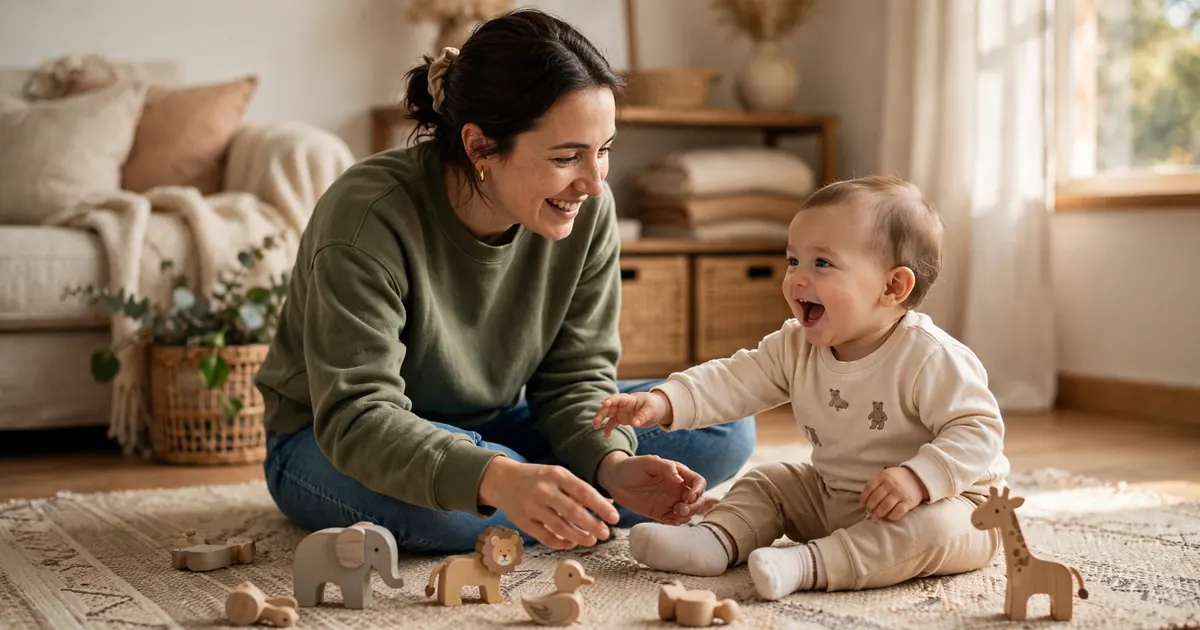
A first word is more than a sound that happens to resemble a word. It counts as a true first word when your baby uses it on purpose, uses it consistently for the same person, object or action, and uses it independently — not only when copying you. The word does not need to sound perfect: a clear, steady approximation such as “ba” for ball can be a genuine first word if your baby uses it deliberately and reliably to mean that thing.
First words are one of the most celebrated moments of early childhood, and one of the most debated. Was that really “mama”, or just happy babbling? Does “woof” count? This page explains what professionals look for when they decide whether a sound is a true word, how first words differ from babble, copied sounds and approximations, and why gestures and signs matter at this stage. It cannot say how your own child is developing — only an assessment can look at the whole picture — but it can help you recognise a first word when one arrives.
Key Takeaways
- A true first word is used deliberately, consistently and independently to mean something specific — perfection of pronunciation is not required.
- Babble that sounds like a word, such as a cheerful “da-da-da”, is valuable practice but is not yet a first word.
- Copied sounds are an important step, but a word becomes the child’s own when they use it spontaneously.
- Animal noises and other playful sound effects often work as early words, because children use them meaningfully and consistently.
- Gestures such as pointing and waving, and signs used deliberately, are real communication — and signing does not hold back spoken words.
- First words arrive across a broad span of time and grow gradually; the overall pattern of communication matters more than a single date.
On this page
- What a first word actually is
- Three signs that a word is a true word
- Sounds that are not quite words — yet
- Communication before words: pointing, gestures and signs
- How first words usually grow
- Gentle ways to encourage first words
- When to seek help
- Questions to ask a therapist
- Frequently asked questions
- Related guides
What a first word actually is
A word is a sound (or a sign) that stands for something. When a baby says “mama” and means you — looks at you, reaches for you, calls for you — the sound is doing the job of a word, however it is pronounced. When the same baby babbles “ma-ma-ma” happily to a toy, to the cat and to nobody in particular, the sounds are identical but the meaning is not there yet.
This distinction matters because it changes how you hear your baby. Parents often undercount first words, listening for perfect pronunciation, and overcount them when a babble string happens to sound like a name. A first word is defined by how it is used, not by how polished it sounds.
First words also tend to be useful words. Early vocabularies are usually built from the people, animals, foods, objects and actions that fill a baby’s days — family names, a pet, “more”, “gone”, “up”, greetings and favourite things. These words earn their place because they get results: saying them brings a person closer, a game back, or a snack into reach. Our complete guide to child speech and language development explains how early words sit within the wider picture of communication development.
Three signs that a word is a true word
Professionals generally look for three features before calling something a first word. Together, they separate a genuine word from the many word-like sounds babies produce.
It is used on purpose
A true word is used with intention: your baby says it to communicate something to someone. There is usually a clear context — reaching towards the biscuit tin while saying “bis”, looking at the door and saying “dada” as a key turns, holding up an empty cup and saying “more”. The sound is aimed at a listener and a goal, not just produced for the pleasure of hearing it.
It is used consistently
The same sound is used for the same thing, again and again, across different days and situations. Consistency is what makes the sound a symbol rather than a coincidence. If “ba” means ball at home, at the park and at Grandma’s house, “ba” is functioning as your baby’s word for ball, even though the adult version has more sounds in it.
It is used independently
Sooner or later, the word appears without prompting: your baby produces it spontaneously, rather than only copying it immediately after you say it. Copying is a vital stepping stone, but the moment a child reaches for a word by themselves — to name something they have spotted or ask for something they want — it has become part of their own vocabulary.
None of this needs to be tested like an exam. You will usually know: there is a particular look, a point, a reach, and a sound you have heard in that situation before — and suddenly you are in no doubt your baby is telling you something.
Sounds that are not quite words — yet
Several kinds of early sounds sit close to words without quite being words. All of them are healthy, valuable steps on the way.
Babble that sounds like a word
Repeated-syllable babble — “ba-ba-ba”, “da-da-da”, “ma-ma-ma” — regularly throws up strings that sound exactly like names and everyday words. Because babble is practice rather than communication with a specific meaning, these are usually happy coincidences. The giveaway is context: babble flows regardless of who or what is present, while a true word turns up when its person or object does. Our guide to babbling in babies describes these stages.
Copied and imitated sounds
Babies and young toddlers copy a great deal: sounds, syllables, whole words, even the tune of your sentences. A word said in immediate imitation — you say “ball”, your baby says “ba” — shows listening, memory and mouth control all developing well. It is not yet an independent word, but echoed words are one of the main routes into spontaneous vocabulary: many first words appear first as copies and only later pop out uninvited.
Animal noises and playful sound effects
“Woof”, “moo”, “brum brum”, “beep” and “uh-oh” deserve special mention, because they often do count as early words. They are short, fun and easy to say, and children use them deliberately and consistently — pointing at a dog and saying “woof”, pushing a toy car and saying “brum”. Used on purpose, in the right situation, again and again, a sound effect is doing the work of a word.
Word approximations
Most first words are approximations: shortened, simplified versions of the adult word. “Ba” for ball or bottle, “ca” for cat, “nana” for banana, “dink” for drink. Young mouths simplify words in predictable ways — dropping final sounds, repeating one syllable, swapping a hard sound for an easier one. An approximation counts as a word when it is used consistently and meaningfully. Over time, approximations gradually sharpen towards the adult form; there is no need to correct them, and hearing the full word said naturally by you is all the “correction” a toddler needs.
Communication before words: pointing, gestures and signs
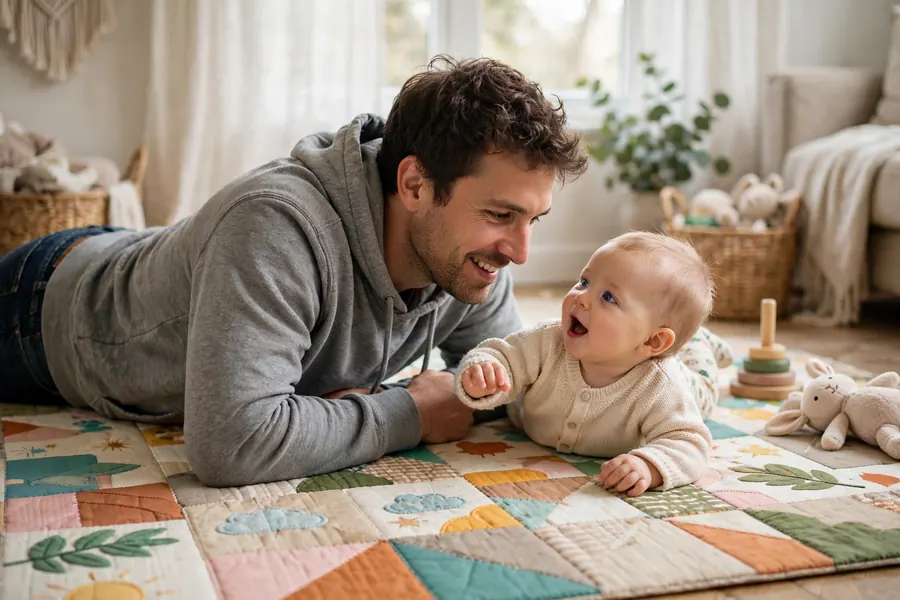
Words are only one part of early communication, and they are not the first part. Long before a first word, babies communicate with looks, reaches, points and waves. Pointing deserves particular attention: when a baby points at something and looks back at you to check you have seen it too, they are sharing interest and attention — one of the foundations spoken language is built on. Waving goodbye, holding arms up to be lifted and shaking the head for “no” are all meaningful messages, counted as part of a child’s communication even though no sound is involved.
Signing sits in the same family. Some families use baby signing — simple gestures alongside everyday words — and some children go on to use signing as part of their longer-term communication. A sign used deliberately and consistently for the same thing works exactly like a spoken word for that child, and is counted as one. Importantly, using signs does not delay spoken words: signing gives a child a way to be understood while speech is developing, and for most children signs are gradually joined by spoken words as talking grows. If gestures are thriving but spoken words are taking longer to arrive, our guide to the signs of speech delay in toddlers explains the wider pattern professionals look at.
How first words usually grow
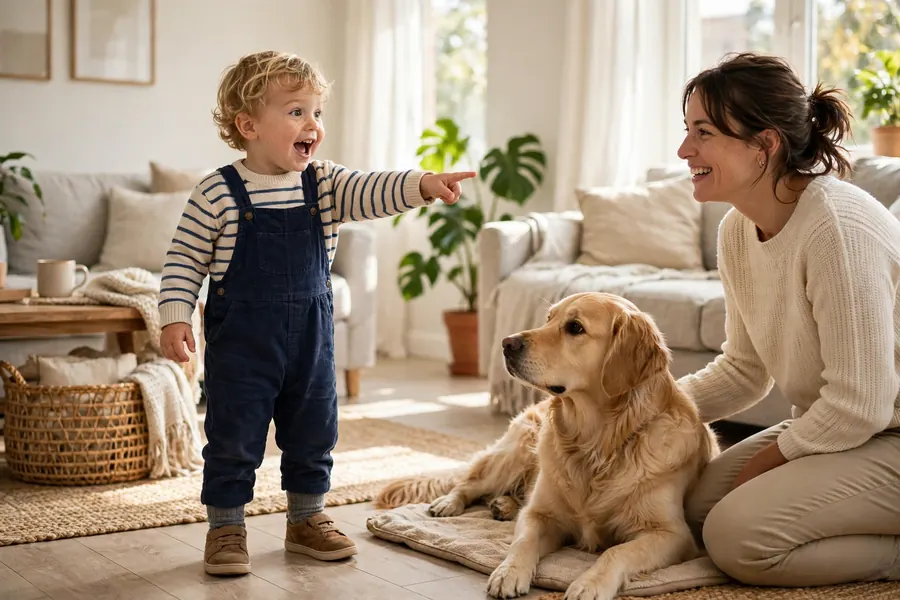
First words rarely arrive as a single dramatic moment followed by fluent speech. A more typical pattern is gradual: one or two words used meaningfully here and there, a pause while those words bed in, then a slow accumulation of new words over the following weeks and months. Some children add words steadily; others gather them in small bursts. Growth also tends to follow a child’s interests: a child who loves vehicles may collect vehicle names and noises first, while another collects animals.
Understanding runs ahead of talking throughout this stage. A child who cannot yet say “shoes” may fetch theirs when asked, and may understand many everyday words long before saying them. This is why professionals look at understanding, gestures, play and interaction alongside spoken words: the word count alone is a narrow slice of a wider picture. Our guide to typical speech and language milestones describes these broad patterns.
Bilingual and multilingual homes have their own equally healthy pattern: a child may use some words in one language and some in another, mixing them freely. What matters is communication growing overall, across all their languages.
Gentle ways to encourage first words
You cannot timetable a first word — first words grow out of ordinary, enjoyable interaction. These ideas are general information, not a programme; they simply make everyday life rich in the experiences words grow from.
- Follow your child’s lead. Talk about what your baby is looking at, reaching for or playing with. Words attached to a child’s current interest are the ones most likely to stick.
- Name things simply and often. Offer the word by itself as well as in short phrases: “Ball! Throw the ball.” Hearing a word many times, in real situations, is how it is learned.
- Say the word your child is reaching for. When your baby points, reaches or uses an approximation, respond with the full word naturally: “Yes — dog! Big dog.” This confirms their message and supplies the adult version without any sense of correction.
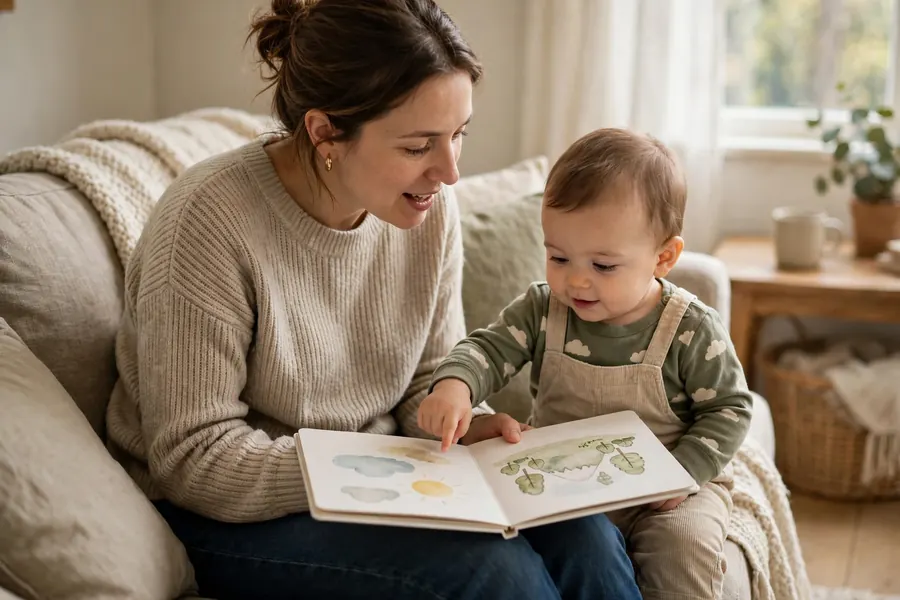
- Leave pauses. After you say something, wait and look expectantly. Toddlers need time to organise a word, and a friendly pause is an invitation, not a test. Sharing simple picture books together works the same way: name the pictures slowly, and follow whichever one your child points at.
- Celebrate approximations. If “ba” means ball in your house, answer as if the word was perfectly clear: “Ball — here it is!” Being understood is the reward that encourages more words, and gestures and signs alongside your words support them rather than competing with them.
When to seek help
Children reach first words across a broad span of time, and a single late word is not, by itself, a verdict on anything. Professionals look at the whole pattern — babbling, understanding, gestures, play, hearing and interaction — as well as spoken words. It is worth seeking advice if:
- Your baby babbles very little, or their sounds are not becoming more varied and word-like over time.
- Your child is not using gestures — such as pointing, waving or showing you things — to communicate.
- Your child seems not to understand familiar words and simple instructions in everyday situations.
- Your child’s few words do not seem to be growing, or none are used independently yet.
- Your child loses words or communication skills they previously had — this deserves prompt advice at any stage.
- Your child’s hearing seems inconsistent, or they often do not respond to sounds and voices.
- You simply feel concerned. You know your child’s everyday communication better than anyone, and asking is a reasonable step at any point.
The usual first step is to talk to your child’s doctor or health visitor, who can arrange a hearing check and refer you to a speech and language therapist; in many places you can also contact a therapist directly. For general information, visit the World Health Organization and the American Speech-Language-Hearing Association (ASHA), or follow your national health authority’s guidance.
One situation is an emergency, and it applies at any age. If a baby, child or adult is choking and cannot clear it, has difficulty breathing, or if someone suddenly loses speech, their face droops on one side, or they have sudden weakness, call your local emergency number immediately.
Questions to ask a therapist
If you arrange an assessment or a first appointment about your child’s early words, these questions can help you feel prepared:
- What will the assessment involve for a child of this age, and is there anything we should bring?
- What have you noticed about my child’s babbling, gestures, understanding and play so far?
- Do the sounds and approximations my child uses count as words, and what would you expect to develop next?
- Should my child’s hearing be checked, and how do we arrange that?
- What can we do at home, within our everyday routines, to encourage words to grow?
- When should we seek advice again if words are still slow to appear?
Frequently asked questions
Does “dada” count as a first word?
It can — but only once it is used as a word. A baby happily babbling “da-da-da” to everyone and everything is practising sounds, and the resemblance is usually a coincidence. When your baby looks towards their father, reaches for him or calls “dada” specifically for him, consistently and on purpose, “dada” has become a true first word.
Do animal noises and sound effects count as words?
Often, yes. Sounds such as “woof”, “moo”, “brum brum” and “uh-oh” are counted as early words when a child uses them deliberately and consistently for the right thing. They are easier for young mouths to produce than many full words, which is why they frequently appear among a child’s first words.
Do signs and gestures count as words?
A sign used deliberately and consistently to mean the same thing works as a word for that child, and professionals count it in the child’s vocabulary. Everyday gestures such as pointing and waving are also real communication. Using signs does not hold spoken words back; it gives a child a way to communicate while speech develops.
Does a word count if only our family understands it?
Yes. Many first words are approximations only familiar listeners can decode at first — “ba” for ball, “dink” for drink. What makes them words is consistent, meaningful use, not clarity to strangers. Clarity sharpens gradually as speech develops.
My child copies words but never says them without copying. What does that mean?
Copying is a genuine step forward: it shows your child is listening, remembering and practising, and echoed words commonly become spontaneous over time. If copying continues for a long stretch without any words appearing independently, or without vocabulary growing, it is worth asking a speech and language therapist to look at the whole picture.
How many words should my child have?
There is no single number that fits every child, and professionals are cautious about treating word counts as pass-or-fail tests. Children vary widely in how quickly vocabulary grows; what matters is the overall pattern — understanding increasing, gestures in use, and words, spoken or signed, gradually being joined by new ones. If growth seems to have stalled, that is a good reason to ask for advice, whatever the current count.
Related guides
- Child speech and language development: a complete guide for parents
- Babbling in babies: what it is and why it matters
- Typical speech and language milestones: broad patterns to look for
- Late talker or speech delay? How to tell the difference
- Signs of speech delay in toddlers: what parents notice first
A gentle next step
The day a sound becomes a word — aimed at you, meaning something, chosen on purpose — is a small moment with a big heart. However your child’s words are arriving, through speech, signs or both, what matters is that the messages are growing. If you would like to talk about your child’s communication, you are very welcome to get in touch online. There is no obligation and no pressure: just a friendly first conversation, at your pace.
By Hamayal Adnan, Speech-Language Pathologist
This article is for general educational purposes only and is not medical advice. It does not replace an assessment by a qualified speech and language therapist or other healthcare professional. Every person is different. If you have concerns about speech, language, feeding or swallowing, please seek professional advice. In an emergency, call your local emergency number.