
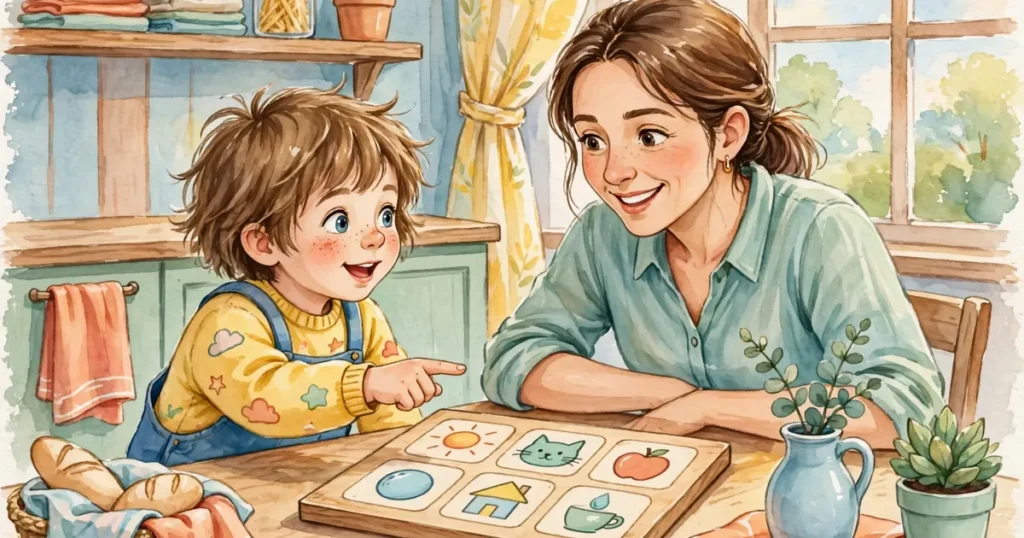
AAC stands for augmentative and alternative communication — all the ways a person can communicate besides, or as well as, speech. A communication board is one of the simplest forms of AAC: a board showing pictures or symbols that a child can point to, look at or touch to share a message — asking for a drink, choosing a game, or saying they have had enough.
If your child finds talking difficult, a communication board can feel like a step into unfamiliar territory. This guide explains what AAC means, the different types of boards, what makes a board work well, and how children learn to use one. It also answers the worries parents most often raise — including the question almost every family asks: will a board stop my child from talking? The short answer is no, and the longer answer is in this guide.
Key Takeaways
- AAC means all the ways of communicating besides or as well as speech — gestures, signing, pictures, symbols and boards are all AAC.
- A communication board is a simple tool: pictures or symbols a child points to in order to share real messages.
- A good board includes the words that matter most to your child, is within reach throughout the day, and has room to grow.
- Children learn a board by watching the people around them use it. Modelling, patience and responding to every attempt matter most.
- Boards support communication; they do not replace or hold back speech. Speech and AAC can grow side by side.
- A speech and language therapist can help match the right board to your child.
On this page
- What does AAC mean?
- Types of communication boards
- What makes a good communication board?
- How children learn to use a board
- Using a board across the day
- Common worries about communication boards
- Communication boards and speech
- Getting an AAC assessment
- When to seek help
- Questions to ask a therapist
- Frequently asked questions
- Related guides
What does AAC mean?
AAC is short for augmentative and alternative communication:
- Augmentative means adding to speech — supporting the talking a child already has, or helping them while speech is still developing.
- Alternative means another way to communicate when speech alone is not enough for a child’s needs right now.
AAC itself comes in two groups:
- Unaided AAC uses only the child’s own body: gestures, facial expressions, pointing and signing. It needs no equipment at all.
- Aided AAC uses something outside the body: a picture, a symbol board, a communication book, or a device that speaks when a button is pressed.
A communication board is an aided, paper-based form of AAC — a single sheet, a mounted board, or a set of pages. The child points to, looks at or touches a picture, and the person with them reads the message aloud and responds.
One idea matters more than any other in this guide: AAC supports communication — it does not replace talking. A board gives a child a way to share messages today, while speech continues to develop in its own time. Communication is the goal; speech is one way of reaching it, a board is another, and the two can happily work together.
Children use AAC for many different reasons. Some are autistic. Some have developmental or learning differences that affect speech and language. Some can talk, but are very hard to understand. Some use a board for a while; others use AAC as their main way of communicating for the long term. All of these are valid.
Types of communication boards
Boards come in several types, and many children use more than one. A therapist can help you work out which combination suits your child.
Choice boards
A choice board shows a small number of options for one moment: two or three snacks, two activities, two songs. The child points to the one they want. Choice boards are often a gentle first step, because the message is simple and the result is immediate. Their limit is that the child can only choose from what is offered — so they are a starting point, not a whole communication system.
Core word boards
A core word board is built around core words: the small, powerful words we use again and again in every situation, such as more, go, stop, help, want, like, finished and again. They usually appear as symbols in a grid, with favourite people, foods, toys and places around the edges.
Core words are powerful because they combine. A child who can point to more and go can ask for more swinging, more tickles, more bubbles and more stories — far more messages than a board full of single nouns could offer. These boards take longer to learn, but they give a child the most room to grow.
Topic boards
A topic board supports one activity or place: bath time, a favourite game, a school lesson, a visit to the park. It holds the words that belong to that situation — things like splash, wash, my turn and all done — and sits alongside the child’s main board.
Personal communication books and passports
A communication book is a portable collection of pages a child carries with them: their board, plus pages about their family and interests. A communication passport is a short booklet written from the child’s point of view, explaining how they communicate, what their gestures and sounds mean, and what helps them. Passports are especially helpful when a child meets new people — a new teacher, a respite carer, a hospital team.
What makes a good communication board?
A board works when it fits the child’s real life. These are the features that matter most:
- Words that matter to your child. Start from your child’s world: favourite foods, people, toys and places. A board full of words an adult chose, but a child never wants, will gather dust.
- Core words as well as names of things. Include flexible words like more, go, help, stop, again, want and finished. These let your child build new messages instead of only picking from a menu.
- Room to grow. Choose a layout with space to add words, so familiar words stay in familiar places as new ones appear.
- Within reach throughout the day. A board only works if it is there: on the table at meals, near the toys at play, by the bath, in the school bag. A board that lives in a cupboard cannot do its job.
- Sturdy enough for real life. Boards get carried, dropped and spilled on. Laminated pages, tough covers and spare copies in more than one place help the system survive ordinary family life.
- Easy for partners to use too. Family, teachers and friends need to find words quickly, because they will be modelling with it. A clear layout, with words in consistent places, helps everyone.
Every child is different. A child who cannot point precisely might use eye gaze, with a partner watching where they look; a child who finds pictures confusing might start with photographs of their own things. A therapist can advise on the format that matches your child.
How children learn to use a board
Children learn a board the same way they learn spoken language: by being surrounded by people who use it with them, for real reasons, over time. Your child needs to see it used, often, before they will use it themselves.
Modelling: the most important strategy
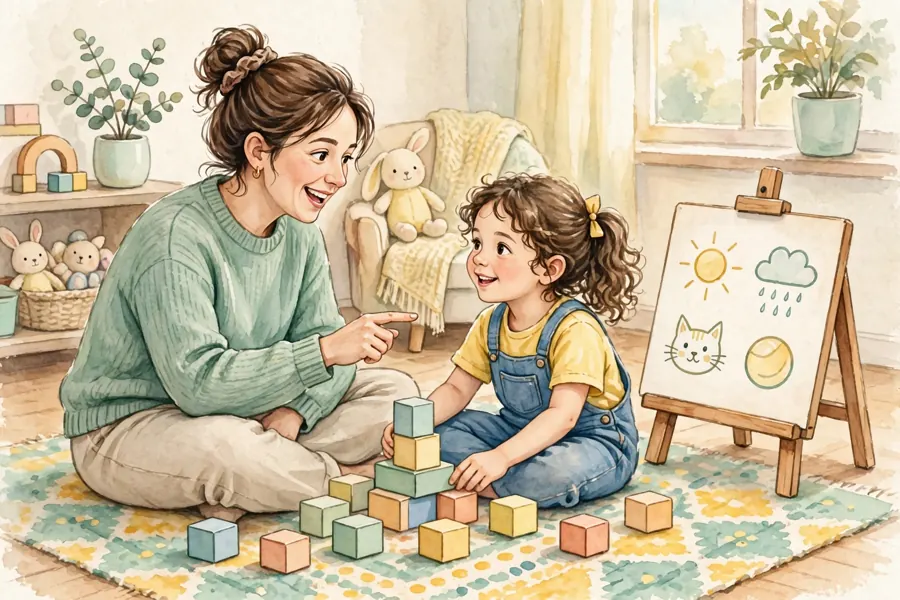
The key approach is called aided language stimulation, which simply means the adult talks and points to words on the board at the same time: “You want more” (pointing to more), “Let’s go” (pointing to go).
Modelling works because it shows your child where words live on the board and what they can do. You do not need to point to every word — just the important ones, a few times a day. Over weeks and months, children begin to reach for the board themselves.
- No pressure. Never insist your child uses the board before you respond to them. If they reach for a biscuit, that reach is communication — respond warmly, then model the word for next time.
- No hand-over-hand forcing. Moving a child’s hand to a symbol teaches them the board is something done to them, not by them. Pointing alongside your child, and waiting, works far better.
- Honour every attempt. A point, a reach, a look, a sound, a gesture — all of these are messages. Respond to the message your child meant.
- Expect it to take time. A long, quiet period of watching before confident use is normal.
Using a board across the day
A board earns its place when it is part of ordinary life. Ideas for weaving it through the day include:
- Meals and snacks: comment and choose — more, finished, yummy, help (for packets and lids), and choosing between foods.
- Play: the richest board time of all — go, again, my turn, stop, fast, uh oh when the tower falls.
- Bath and routines: topic words for washing, splashing, drying and getting dressed. A spare waterproof copy near the bath helps.
- School and nursery: the board travels with your child, and staff model with it during lessons, play and lunch.
- Out and about: a copy in the bag means your child can comment and choose at the park, the shops or a family visit.
Many families keep copies of the same board in several spots — home, school, grandparents’ house, the car — with the words in the same places on every copy, so your child never has to relearn the layout.
Common worries about communication boards
Almost every family has the same handful of worries at the start. They are all reasonable — and all have reassuring answers.
“It feels so slow”
At first, yes. Finding a symbol takes longer than speaking a word, and modelling can feel clumsy while you learn the layout yourself. Speed grows with familiarity, for your child and for you. Slow, successful communication is worth far more than a child left unheard. Give your child plenty of waiting time to find their word.
“Will siblings and friends join in?”
Usually, enthusiastically. Brothers, sisters and classmates often learn the board quickly and enjoy using it. Encourage siblings to model during play and include the board in games, so it belongs to everyone’s fun, not only to therapy time.
“My child just plays with the board”
Flipping pages, pointing at favourite pictures over and over, or carrying the board around are all part of learning it. Babies babble before they talk; children explore a board before they use it with purpose. Keep responding as if each touch might be a message — say the word aloud, react to it — and purposeful use grows out of that play.
Communication boards and speech
This is the worry at the heart of many parents’ questions, so it deserves a clear answer: using a communication board does not stop speech from developing. Families are never asked to choose between a board and talking.
Think of it this way. A board takes the pressure off. A child who can share a message — any message — experiences the joy of being understood, and that success encourages more communication of every kind, including sounds, word attempts and speech. Modelling also teaches spoken words: every time you point to more you say “more” aloud, so your child hears and sees the word together.
Communication comes first. Some children use a board while their speech catches up, and gradually speak more and point less. Others continue to use both for the long term. Both paths are fine — what matters is that your child can say what they want to say.
Getting an AAC assessment
A speech and language therapist can carry out an AAC assessment, which generally involves:
- Getting to know your child: how they communicate now, what they understand, how they point or look, what motivates them, and where communication is hardest.
- Choosing a starting system: matching the type of board, symbols, layout and first vocabulary to your child’s skills and daily life.
- Trying it out: using the board together for a while, watching what works, and adjusting as needed.
- Reviewing over time: as your child grows, their vocabulary, interests and skills change, and the board should grow with them. Review is a normal, expected part of AAC.
If your child is at school or nursery, it helps when therapist, family and school staff all use the same system, so it stays consistent everywhere.
When to seek help
Using a board at home is a gentle step any family can explore. It is worth seeking professional advice if:
- Your child has very few reliable ways to share messages — wants, needs, choices, refusals — and often seems frustrated or withdrawn when trying to communicate.
- Your child’s communication does not seem to be moving forward: no new words, sounds, gestures or board skills over time.
- You are unsure which board, symbols or vocabulary would suit your child, or a board you tried is not being used.
- You simply feel worried. You do not need to wait for a particular stage before asking — advice and reassurance are both good outcomes.
One pattern deserves prompt advice at any age: losing skills. If your child stops using words, sounds, gestures or ways of interacting they had before, seek professional advice promptly.
One situation is an emergency. If a child suddenly loses speech, their speech suddenly becomes slurred or very hard to understand, their face suddenly droops on one side, or they have sudden weakness, choking or difficulty breathing, call your local emergency number immediately.
The usual first step is to talk to your child’s doctor or another health professional, or to their teacher, who can point you towards a speech and language therapy assessment. You can also contact a speech and language therapist directly.
Questions to ask a therapist
If you arrange an assessment or a first appointment, these questions can help you feel prepared:
- Which type of board would suit my child best to start with, and why?
- Which words should we begin with, and how will the board grow over time?
- How should we model on the board at home, and how often?
- How can school or nursery use the same system, so the words are consistent everywhere?
- What signs of progress should we watch for, and when should we review the board together?
Frequently asked questions
What age can a child start using a communication board?
There is no set age. A board can be introduced whenever a child would benefit from another way to share messages, whether they are very young or older and already using some speech. What matters is matching the board to the child.
Will a communication board stop my child learning to talk?
No. Boards support communication while speech develops; they do not replace speech or hold it back. Children who use boards keep hearing spoken words modelled all day, and many use a mixture of speech, gestures and pointing. Communication first — speech and AAC grow together.
Should we start with pictures, photographs or symbols?
It depends on the child. Some understand photographs of their own things most easily; others manage simple picture symbols straight away. Many systems mix them. A therapist can help you choose a starting point.
What if my child cannot point accurately?
Pointing with a finger is only one way to use a board. Children can look at the picture they mean (eye gaze), touch with a whole hand, or have a partner name each option while watching for a “yes” response. An assessment matches the board’s size, layout and access method to how your child moves.
How long before my child uses the board by themselves?
It varies a great deal. Children usually need to see the board modelled for some time before they use it confidently themselves — just as babies listen for a long time before they talk. Steady modelling, patience and responding to every attempt are what build independent use.
Can we make a simple board ourselves at home?
Yes — many families start with a simple homemade choice board for favourite foods and activities, and that is a perfectly good first step. For a fuller system that will grow with your child, a therapist’s guidance helps you choose vocabulary and layout well from the start.
Related guides
- Autism, ADHD and social communication: a complete guide
- How to support a non-speaking child
- Support for children and parents: the For Kids and Parents hub
- Free resources for families
- Browse all conditions and topics
A gentle next step
Starting with a communication board is not giving up on speech — it is giving your child a voice today, while everything else keeps growing. If you would like to talk about which board might suit your child, you are very welcome to get in touch online. There is no obligation and no pressure: just a friendly first conversation, at your pace.
By Hamayal Adnan, Speech-Language Pathologist
This article is for general educational purposes only and is not medical advice. It does not replace an assessment by a qualified speech and language therapist or other healthcare professional. Every person is different. If you have concerns about speech, language, feeding or swallowing, please seek professional advice. In an emergency, call your local emergency number.