
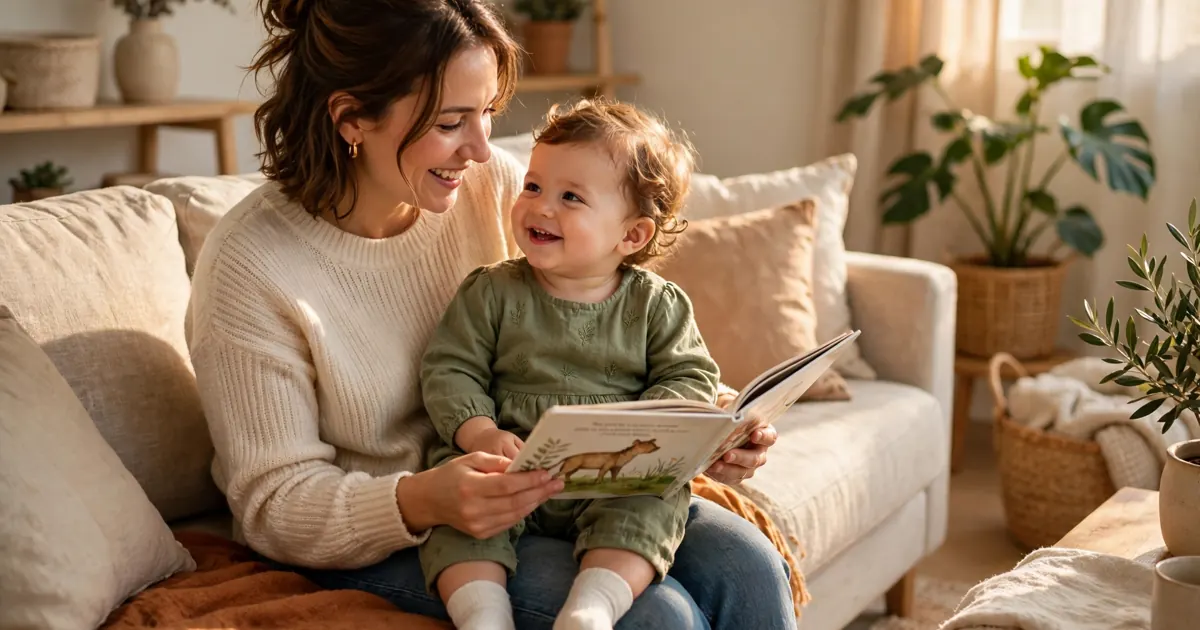
Typical speech and language milestones describe the broad patterns in how most children learn to communicate — from early sounds and listening, through first words, to sentences, stories and conversation. They are best understood as wide, overlapping ranges rather than fixed steps or deadlines, because every child develops at their own pace and in their own order. This guide explains the pattern, why ranges are wide, and when to seek advice.
Milestone lists can be reassuring — and worrying, when they seem to suggest your child should be doing something they are not doing yet. Used gently, milestones are simply a map of how communication usually grows. They cannot say whether an individual child has a difficulty — only an assessment can do that.
Key Takeaways
- Milestones describe broad patterns of development, not strict ages, tests or deadlines.
- Communication grows in overlapping stages: listening and understanding, sounds and babble, first words, joining words, sentences, and clearer speech.
- Children develop at very different rates — progress over time matters more than any single step.
- Understanding usually runs ahead of talking, and gestures, play and interaction are part of the picture too.
- Children learning more than one language follow the same broad patterns, with skills spread across their languages.
- If you are worried at any stage, asking for advice is always a reasonable step.
On this page
- Milestones are patterns, not deadlines
- The early months: listening, sounds and first exchanges
- Babbling and first meaningful words
- The toddler years: words build and begin to join
- The preschool years: sentences, stories and clearer speech
- The school years: language for learning and friendship
- Understanding grows alongside talking
- Why the ranges are so wide
- Children learning more than one language
- Everyday ways to support communication
- When to seek help
- Questions to ask a therapist
- Frequently asked questions
- Related guides
Milestones are patterns, not deadlines
When professionals talk about milestones, they mean skills that most children develop somewhere within a broad stretch of early childhood — not skills that appear on a particular birthday. A milestone is a general observation about how development usually unfolds. It is not a promise about your child, a test your child can pass or fail, or a deadline they must meet.
This distinction matters. Two children can both be developing typically while reaching the same skill at quite different times. One may walk early and talk later; another may talk early and be slower with physical skills. Development is not a race, and it rarely follows a neat staircase. So rather than asking “should my child be doing this by now?”, a more helpful question is “is my child making progress over time, in their own way?” The sections below describe the usual broad pattern, stage by stage.
The early months: listening, sounds and first exchanges
Communication begins long before words. In the early months of life, babies are already listening, watching faces and learning the back-and-forth rhythm of interaction — the foundations everything else is built on. Broadly, during this stage babies gradually learn to:
- Turn towards sounds and voices, and show they recognise familiar voices.
- Watch faces closely and respond to smiles and expressions.
- Make early sounds — cooing, gurgling and other soft noises — especially during interaction.
- Show pleasure, interest or discomfort through sounds, movements and facial expressions.
- Enjoy back-and-forth exchanges, where a sound or smile is answered and the baby responds again.
These exchanges are the earliest form of conversation: a baby who looks, listens and responds is already communicating. Parents support this stage by being face to face, talking gently, singing, and responding to their baby’s sounds.
Babbling and first meaningful words
As babies grow through their first year or so, their sounds become more varied and more speech-like. Babbling — strings of repeated sounds such as “ba-ba-ba” or “da-da-da” — is typical at this stage, and over time it begins to sound more like the rhythms of the language around them. Around this broad stage, children also typically:
- Use gestures more deliberately, such as reaching, waving, showing things and pointing.
- Understand familiar words in everyday routines, such as names of family members or everyday objects, before they can say them.
- Respond to their own name and to simple everyday phrases within familiar routines.
- Begin to use first meaningful words — a sound or word used consistently for the same person, object or action.
First words arrive across a wide range of timing, and early words are often imperfect versions only familiar adults recognise. What matters is the direction of travel: sounds becoming more varied, gestures used to share messages, and understanding growing underneath. Some children’s words appear in a gentle trickle; others gather slowly, then make a sudden leap. Both can be entirely typical.
The toddler years: words build and begin to join
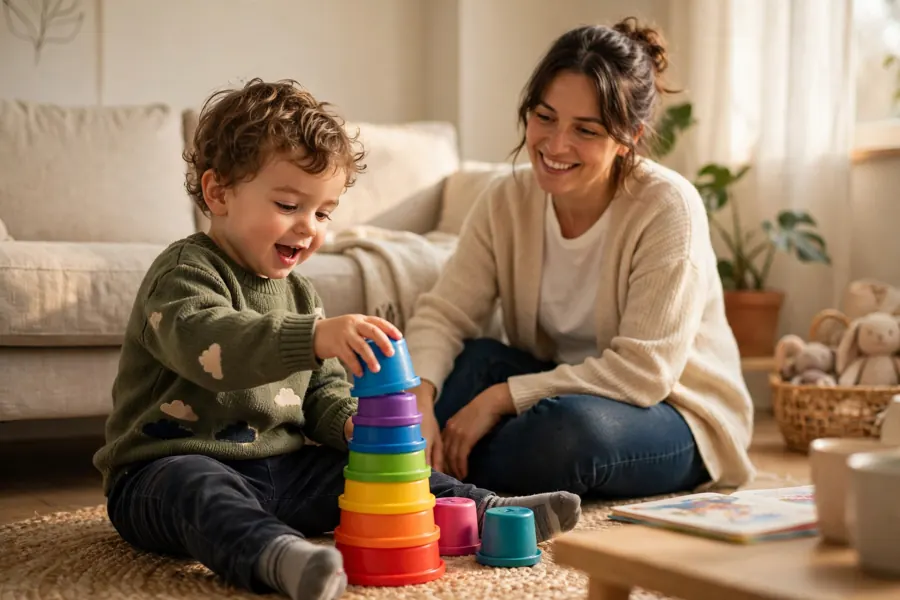
During the toddler years, talking becomes a bigger part of everyday life. Vocabulary generally grows over time, moving from mostly names for favourite people and things towards a wider mix including action words such as “go” and “eat”, and social words such as “more” and “bye”.
Broadly, across this stage toddlers gradually learn to:
- Use a growing set of words, at their own pace, for things they want, see and do.
- Put two words together to make simple combinations, such as naming who is doing something or what they want.
- Follow simple instructions in familiar situations, and understand more words than they can say.
- Use speech sounds that are still developing — toddler speech is naturally unclear, and young children simplify longer words in predictable ways.
- Communicate for more reasons: to ask, refuse, comment, greet, and share something interesting.
Progress here is rarely smooth: quiet spells where few new words appear often alternate with periods of rapid change, while understanding, play and gestures keep developing throughout.
The preschool years: sentences, stories and clearer speech
In the preschool years, language usually becomes more detailed and flexible. Sentences grow longer and more organised, and children begin to talk not just about the here and now, but about things that have happened, things they imagine, and things they plan to do.
Broadly, across this stage children gradually learn to:
- Join words into longer sentences and use small grammar words, such as “the”, “is” and endings that show past time or more than one.
- Ask and answer simple questions about everyday topics.
- Tell simple stories or recount events in an order that others can follow.
- Take turns in conversation and stay on a topic for longer.
- Use a wider range of speech sounds, so their speech becomes easier for people outside the family to understand — though some sounds take longer to settle, and clarity keeps improving gradually over this whole period and beyond.
- Play imaginatively with other children, using talk to negotiate roles and ideas.
Speech clarity deserves a special note, because it worries many parents. Preschool speech is typically still a work in progress: sounds are learned gradually, and unfamiliar listeners may not understand everything. Steady improvement over time is the reassuring pattern. More on how speech sounds develop is available from the American Speech-Language-Hearing Association (ASHA).
The school years: language for learning and friendship
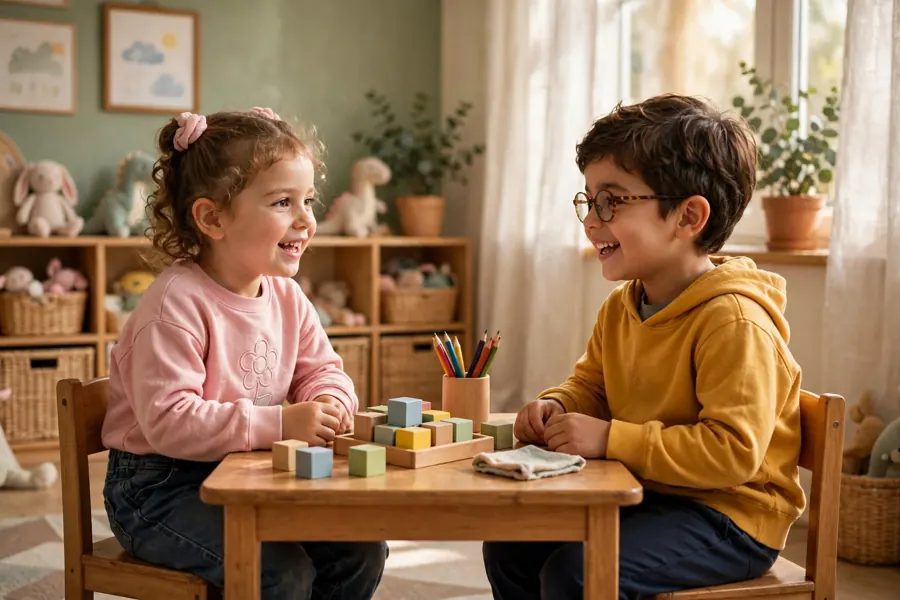
Starting school changes what language is for: children use it to learn new subjects, follow complex instructions, reason, explain and build friendships. Vocabulary keeps growing throughout childhood — there is no finish line.
Broadly, across this stage children gradually learn to:
- Understand and use longer, more complex sentences, in conversation and in reading and writing.
- Follow instructions with several parts, and remember verbal information.
- Use language to explain, predict, persuade and solve problems with others.
- Understand jokes, wordplay and the difference between what words say and what a speaker means.
- Tell and write organised stories and accounts, with a beginning, middle and end.
Because school places new demands on language, some difficulties only become obvious at this stage — a child who chatted happily as a preschooler may find the language of lessons harder. That does not mean a problem was missed earlier; the demands have changed. If school raises concerns, follow up.
Understanding grows alongside talking
Milestone lists often focus on talking, because talking is what we hear. But understanding — receptive language — is half of communication, and it quietly leads the way: children generally understand words and phrases before they use them, at every stage. When you think about milestones, hold both halves together:
- Understanding: what your child takes in — words, instructions, questions, stories.
- Talking: what your child puts out — sounds, words, sentences, conversation.
A child can be ahead in one half and slower in the other. If understanding seems limited too, mention it when you seek advice.
Why the ranges are so wide
Parents sometimes feel milestone information is frustratingly vague. There are honest reasons for that:
- Children are individuals. Temperament, interests, health and personal style all influence how and when skills appear.
- Development overlaps. A child works on sounds, words, sentences, play and social skills all at once, at different speeds.
- Progress comes in bursts and plateaus. A quiet period is often consolidation, not a standstill.
- Families and settings differ. Children with older siblings, children in group childcare and only children all have different daily language experiences, and all can develop typically.
Because of all this, no responsible guide can give exact ages by which a child must do something. Professionals look instead at the overall pattern: Is communication developing across sounds, words, understanding, play and interaction? Is there steady movement forward? Are there signs — such as skills being lost — that deserve prompt advice regardless of age? Our guide to signs of speech delay in toddlers explains those signs in more detail.
Children learning more than one language
Many children grow up with two or more languages, and they follow the same broad milestone patterns as children with one language. A few normal features are sometimes worried about unnecessarily:
- A child’s words are spread across their languages, so counting words in only one language can make their total vocabulary look smaller than it is.
- Mixing languages within a sentence is typical and is not a sign of confusion.
- A child may go through a quieter period when starting a setting where a new language is spoken, while they listen and absorb.
- Understanding may be stronger in one language and talking stronger in another, depending on where each is used.
Learning more than one language does not cause speech or language difficulties. If a difficulty is present, it shows in every language, not just one. Keep chatting, reading and singing in whichever language your family speaks most comfortably.
Everyday ways to support communication
Whatever stage your child is at, everyday life is full of language-learning opportunities. These ideas are not a treatment and do not replace an assessment, but they support communication at every stage:
- Talk during routines. Meals, bath time, journeys and getting dressed are full of repeated, predictable words — ideal learning material.
- Follow your child’s lead. Talk about what they are looking at, playing with or doing, rather than redirecting them.
- Give time to respond. After you speak, pause. Children need longer than adults to understand and reply.
- Expand gently. Repeat what your child says and add a little. If they say “dog”, you might say “yes, a big dog”.
- Comment more than you question. Too many “what’s this?” questions can feel like a test. Comments keep conversation relaxed.
- Share books, songs and rhymes. Looking at books together and revisiting favourites builds vocabulary and understanding at every age. General information is also available from the World Health Organization and the National Institute on Deafness and Other Communication Disorders (NIDCD).
- Respond to every attempt. A look, a gesture, a sound, a sign or a word — responding warmly teaches your child that communicating works.

When to seek help
Milestones are a guide, not a gatekeeper: you do not need to wait for a particular age or stage before asking for advice, or to be certain something is wrong. It is worth seeking advice if:
- Your child’s talking, understanding or interaction is noticeably behind the broad pattern for their stage, and the gap seems to be widening rather than closing.
- Progress seems to have stalled — sounds, words, understanding or play are not moving forward over time.
- Your child’s speech stays very hard for familiar adults to understand, without gradual improvement.
- Your child seems frustrated or withdrawn when trying to communicate, or is communicating much less than before.
- You have concerns about your child’s hearing as well as their talking.
- School or nursery staff raise concerns about understanding, talking, learning or friendships.
- You simply feel worried. Asking early is always reasonable; many parents find our guide to late talker or speech delay helpful.
One pattern deserves prompt advice at any age: losing skills. If your child stops using words, sounds or ways of interacting they had before, seek professional advice promptly rather than waiting to see.
One situation is an emergency. If a child suddenly loses speech, their speech suddenly becomes slurred or very hard to understand, their face suddenly droops on one side, or they have sudden weakness, choking or difficulty breathing, call your local emergency number immediately.
The usual first step is to talk to your child’s doctor or another health professional, or to a health visitor or teacher if you have one. You can also contact a speech and language therapist directly. For general information, visit the World Health Organization and the American Speech-Language-Hearing Association (ASHA), or follow your national health authority’s guidance.
Questions to ask a therapist
If you arrange an assessment, these questions can help you feel prepared:
- What will the assessment involve, and is there anything we should bring or prepare?
- What are my child’s communication strengths, and which areas need the most support?
- How does my child’s development fit the broad typical pattern, and what would you expect to see developing next?
- Should my child’s hearing be checked, and how do we arrange that?
- What can we do at home, within our everyday routines, to support our child’s communication?
- What changes should we watch for over the coming months, and when should we seek advice again?
Frequently asked questions
My child reached some milestones later than friends’ children. Should I worry?
Not necessarily. The ranges are wide, and children reach skills in different orders and at different speeds. What matters most is steady progress over time. If progress stalls, or you feel worried, asking for advice is always reasonable.
Are milestone checklists a test my child can fail?
No. Milestones are general descriptions of how development usually unfolds, not tests with pass marks or deadlines. A checklist can help you notice what your child is doing, but it cannot say whether an individual child has a difficulty — only an assessment can do that.
My child does some things on the list for an older stage but not for their own stage. Is that normal?
It can be. Development is uneven, and skills overlap between stages. Many children show a scattered pattern — stronger in some areas, still growing in others. The overall pattern matters more than any tidy sequence.
Do milestones apply to children learning two languages?
Yes — the same broad patterns apply. A multilingual child’s skills are spread across their languages, mixing languages is normal, and their total communication is what counts. If a difficulty exists, it appears in all of a child’s languages, not just one.
What if my child loses a skill they had before?
Losing skills — for example, stopping using words or ways of interacting that were there before — deserves prompt professional advice at any age. Mention it clearly when you contact your child’s doctor or a speech and language therapist, rather than simply waiting for the skill to return.
How can I keep track of my child’s progress?
Simple notes help: new words, new combinations, things your child understands, and how they play and interact. Occasional notes reveal the pattern of progress far better than checking a list every day, and give a professional a helpful starting point.
Related guides
- Child speech and language development: a complete guide for parents
- Signs of speech delay in toddlers: what parents notice first
- Late talker or speech delay? How to tell the difference
- Browse all conditions and topics
A gentle next step
Milestones are best used as a friendly map: they show how communication usually grows, while your child follows their own route. If you would like to talk about where your child is on that journey, you are welcome to get in touch online. No obligation, no pressure.
By Hamayal Adnan, Speech-Language Pathologist
This article is for general educational purposes only and is not medical advice. It does not replace an assessment by a qualified speech and language therapist or other healthcare professional. Every person is different. If you have concerns about speech, language, feeding or swallowing, please seek professional advice. In an emergency, call your local emergency number.