
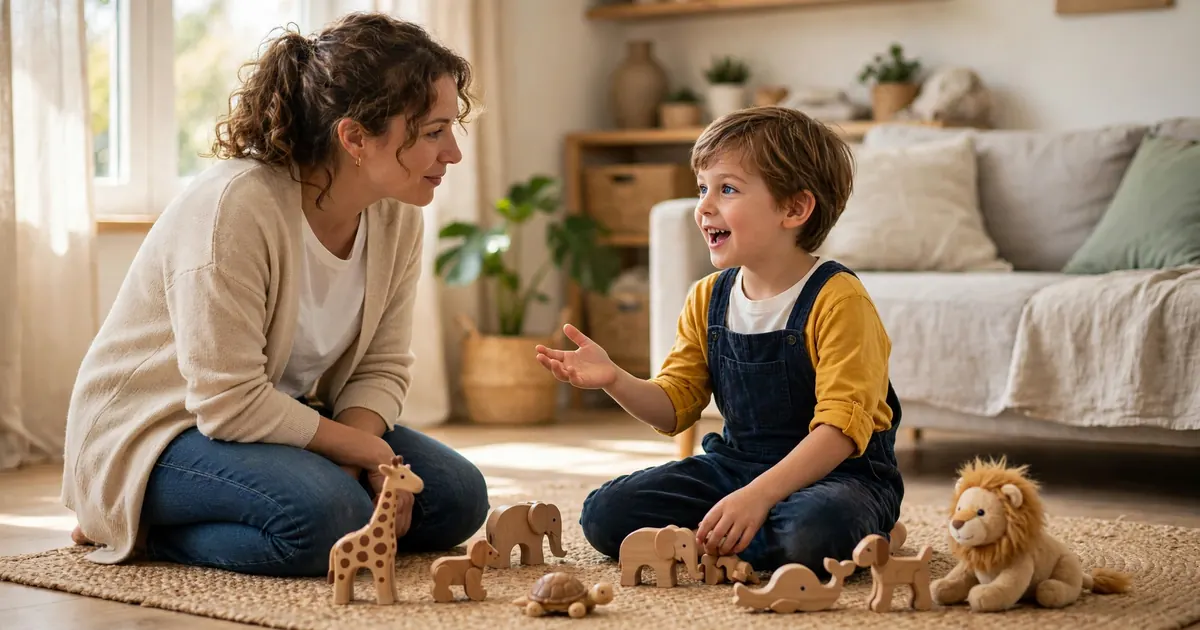
Echolalia is the repetition of words and phrases that a child has heard — echoing back something said by another person, or a line from a favourite programme, song or story. Far from being meaningless or a habit to stop, repeating is often a genuine part of how a child learns language and communicates: the repeated words frequently carry real meaning, comfort or connection for the child.
If your child repeats your questions back, recites scenes from a much-loved programme, or says the same phrase many times a day, you are hearing something worth listening to. This article explains what echolalia is, the difference between immediate and delayed repetition, why children repeat, and gentle ways to respond.
Key Takeaways
- Echolalia means repeating words or phrases a child has heard, either straight away (immediate) or later on (delayed).
- Repetition is a normal part of early language learning for many children, and for some children it is a longer-lasting way of building and using language.
- Repeated phrases often carry real meaning — a whole phrase can stand for a request, a feeling, a memory or a wish to connect.
- Some children learn language in chunks first, borrowing ready-made phrases and gradually breaking them down into flexible, self-made sentences.
- Responding with curiosity — listening for the meaning behind the repetition — is more helpful than correcting it or asking a child to “say it properly”.
- If you are worried about your child’s communication overall, a speech and language therapy assessment can help you understand what the repetition means for your child.
On this page
- What echolalia is
- Immediate and delayed echolalia
- Why children repeat words and phrases
- Repetition often carries real meaning
- Echolalia, autism and typical development
- Gentle ways to respond
- When to seek help
- Questions to ask a therapist
- Frequently asked questions
- Related guides
What echolalia is
Echolalia comes from the word “echo”, and that is a good way to picture it: a child hears words and reflects them back. The repetition might be exact — word for word, in the same tone of voice — or it might be slightly changed, with a word swapped or the ending adjusted.
Almost all young children echo as they learn to talk. Babies and toddlers copy sounds, words and whole phrases constantly; imitation is one of the main engines of early language learning. For many children, echoing is a brief and barely noticed stage on the way to building their own sentences. For other children, repetition plays a bigger and longer-lasting role: they rely on borrowed phrases as a real part of how they communicate, sometimes for years.
Think of echolalia not as a behaviour in itself, but as a window: what a child repeats, when they repeat it, and how it changes over time can tell you a great deal about how they are learning language and what they are trying to say.
Immediate and delayed echolalia
Echolalia is usually described in two forms, and many children show both.
Immediate echolalia
Immediate echolalia is repetition that happens straight away, or within a few moments. A child is asked “Would you like some juice?” and answers “Like some juice” — or repeats the whole question back. Sometimes the echo is a way of saying yes. Sometimes it buys the child time to process what was said. Sometimes it is simply how the child joins in the conversation while their own answer takes shape.
Delayed echolalia
Delayed echolalia is repetition that comes later — hours, days or even months after the words were first heard. Children repeat lines from programmes, songs, stories, adverts or things adults have said. A child might recite a whole scene word-perfectly while playing, greet a situation with a catchphrase borrowed from a favourite character, or produce a phrase a grandparent used last week. Because the words arrive out of context, delayed echolalia can sound puzzling at first — until you recognise where the phrase came from, and what it might be doing there.

Why children repeat words and phrases
Children repeat for many reasons, and often several are at work at once.
Learning language in chunks
Some children build language one word at a time, gradually combining words into their own sentences. Others take a different route: they first learn whole chunks — complete phrases picked up as single units, like a song learned in one piece rather than note by note. This is sometimes called gestalt language processing. A chunk like “let’s get out of here” might first be used as one unanalysed whole. Over time, the child may begin to break chunks down: swapping a word, using part of the phrase in a new sentence, and eventually building flexible, original language from the pieces. Both routes are ways of learning to talk.
Communicating a message
A repeated phrase is often the message. A child who has not yet built the sentence they need may borrow the nearest ready-made one that fits. The child who says “Do you want a biscuit?” while holding out their hand may be asking for a biscuit, using the words they have heard in exactly that situation. Listening to when a phrase appears is often the clue to what it means.
Comfort and regulation
Familiar words can be soothing. Repeating a loved phrase, a line from a calming scene or a few words from a parent can help a child feel settled — in the same way that humming a familiar song can. Repetition may increase when a child is tired, excited, anxious or in an unfamiliar place, precisely because the familiar words help.
Processing time and joining in
Repeating what was just said can hold a conversation open while the brain catches up — a way of saying “I heard you, I’m thinking”, and of taking a turn while an original reply takes shape.
Enjoyment of sound and play
Some repetition is simply fun: words have rhythm and music, and repeating a silly phrase until everyone laughs is a social game as old as childhood.

Repetition often carries real meaning
This is the heart of understanding echolalia: a repeated phrase is rarely random. More often, it is attached to a situation, a feeling or a memory, and it does a job. For example:
- A request. A phrase heard at snack time may become the child’s way of asking for food or drink.
- A feeling. A line from a story about a character who was frightened, cross or delighted may appear whenever your child feels something similar — it is the closest words they have for that emotion.
- A memory or association. A phrase from a happy day out may be produced when your child sees something that reminds them of it, or wants to go again.
- A warning or rule. Words an adult used in a tense moment — “careful, it’s hot” — may be repeated by the child in similar situations, as self-talk that helps them manage.
- Connection. Sharing a beloved catchphrase can be an invitation: to laugh together, to play the scene, to be close. It is a bid for shared joy, not meaningless noise.
Because the meaning is personal — tied to where the phrase was first heard — families are often the best interpreters. You may be the only people who know that a particular line comes from a programme scene about feeling left out, and that your child says it when play goes wrong. That detective work is valuable, and it is worth sharing with anyone who works with your child.
Echolalia, autism and typical development
Repetition is part of typical development: most toddlers echo words and phrases as language grows, and this usually fades into the background as their own flexible sentences take over.
Echolalia is also commonly talked about alongside autism, because many autistic children use repetition as a significant part of their communication — learning in chunks, scripting favourite scenes, and using borrowed phrases to express real meanings. For these children, echolalia is often not a stage that disappears but a foundation that language is built on, developing over time into more flexible, self-generated speech.
It is important to hold both truths at once. Repetition on its own does not diagnose anything: it appears in typical development, in autism, and alongside other language differences — our pillar guide to autism, ADHD and social communication sets this in wider context. What matters is the whole picture of your child’s communication — how they understand, connect, play and express themselves — which is something an assessment can explore and no checklist can decide. Echolalia is one thread in that picture, and for many children it is a strength to build on, not a problem to remove.
Gentle ways to respond
How you respond can make repetition feel heard rather than corrected. These ideas are general information about everyday communication, not a therapy programme.
- Listen for the meaning first. Ask yourself what your child might be communicating — a request, a feeling, a memory, a wish to connect — and respond to that meaning. Being understood is what encourages more communication.
- Acknowledge the phrase. A smile, a nod, or joining in with the next line shows your child their words landed. For many children, sharing a script together is a moment of real connection.
- Model simple language from your child’s point of view. Offer the words your child might use themselves, in short, natural phrases: if your child echoes “Do you want juice?” to ask for a drink, you might say “I want juice” as you pour. Modelling gives them borrowable chunks that match their meaning.
- Comment more than you question. A stream of questions can be hard work to answer. Friendly comments — “That train is fast”, “You love that part” — are easier to join in with, and they feed language in without pressure.
- Keep your own language clear and unhurried. Short, natural sentences, one idea at a time, with pauses, give your child time to process and respond in their own way.
- Avoid demanding “say it properly”. Asking a child to replace their borrowed phrase with a “correct” one can remove the only words they currently have for that meaning, and turn conversation into a test. Their phrase is their communication — build from it, rather than taking it away.
- Note what phrases mean. If you crack the code on a favourite phrase, share it with nursery, school and family. A shared phrasebook helps everyone respond to your child with understanding.
These everyday responses sit alongside the wider social side of communication, explored in our guide to pragmatic language — the social use of language.
When to seek help
Echolalia by itself is not an emergency, and repetition alone is not a reason to worry. It is worth seeking advice about your child’s communication if you notice echolalia alongside any of the following:
- Your child relies heavily on repeated phrases and is finding it hard to build their own flexible sentences over time.
- Your child’s understanding of everyday language seems limited, or they often seem not to follow what is said.
- Communication differences are affecting play, friendships, learning or your child’s confidence — see also our guide to signs of social communication difficulty.
- Your child becomes very frustrated when trying to communicate.
- Your child uses very little spoken language and you would like to explore all their communication options — our guide to supporting a non-speaking child may help.
- You simply feel unsure. Asking for an assessment is a reasonable step; you do not need to be certain first.
One pattern deserves prompt advice at any age: losing skills. If a child stops using words or communication skills they had before, seek professional advice promptly.
One situation is an emergency. If someone suddenly loses speech, their face suddenly droops on one side, they have sudden weakness, or they are choking or having difficulty breathing, call your local emergency number immediately.
The usual first step is your child’s doctor, health visitor or teacher, who can point you towards a speech and language therapy assessment; in many places you can also contact a therapist directly. General information about children’s communication development is available from the American Speech-Language-Hearing Association (ASHA).
Questions to ask a therapist
These questions can help you get the most from an assessment or first appointment:
- How does my child seem to be learning language — in single words, in chunks, or a mixture?
- What do you think my child’s favourite repeated phrases might mean, and how can we check?
- Which phrases could we model at home that would give my child useful, borrowable language?
- How can family, nursery or school respond to repetition in a consistent, supportive way?
- What goals would you suggest, and how will we know my child’s language is becoming more flexible?
Frequently asked questions
Is echolalia normal?
Yes — echoing words and phrases is a normal part of how many young children learn language. Toddlers copy constantly, and repetition usually becomes less prominent as a child’s own sentences grow. For some children, repetition remains an important part of communication for longer, and it can develop over time into more flexible language. It is the overall picture of your child’s communication that matters, not repetition alone.
Is echolalia a bad habit we should stop?
No. Repetition is communication and, for many children, a stepping stone in language learning. Trying to stop it — or taking the phrases away by insisting on different words — can remove a child’s main way of expressing meaning. The more helpful approach is to understand what the repetition is doing for your child and respond to it, while modelling language they can borrow next.
What is the difference between immediate and delayed echolalia?
Immediate echolalia is repetition that happens straight after hearing something — echoing a question or the last few words of a sentence. Delayed echolalia comes later: repeating lines from programmes, songs, stories or earlier conversations, sometimes long afterwards. Both are echolalia, and both can carry meaning. Delayed repetition can look puzzling until you recognise the source and the situation it is attached to.
Does echolalia mean my child is autistic?
No. Echolalia appears in typical development and can also be part of how many autistic children communicate, as well as appearing alongside other language differences. Repetition alone cannot diagnose anything. If you are wondering about your child’s development overall, a doctor is usually the first step; a speech and language therapist can describe your child’s communication in detail as part of that wider picture.
My child repeats lines from programmes word-perfectly but cannot answer simple questions. Why?
Repeating a memorised line and answering a question are different skills. A script is already formed — the words are ready-made. Answering a question means understanding what was asked and building a new sentence from scratch, which is much harder work. Many children who learn language in chunks show exactly this pattern, and with time and support the chunks often begin to break down into flexible language of their own.
Should I repeat things back to my child?
Joining in can be lovely — sharing a favourite line together is connection, and acknowledging what your child says shows it landed. Alongside that, model short phrases from your child’s point of view (“I want more”, “that was funny”) that match what they might want to say. There is no need to echo everything back as a technique; follow your child’s lead and keep it natural and warm.
Will echolalia go away?
For many children, repetition gradually gives way to flexible, self-built sentences as language grows. For others, borrowed phrases remain a valued part of how they communicate, becoming more varied and flexible over time. There is no single path, and progress varies from child to child. What helps most is understanding the meaning behind the repetition.
Related guides
- Autism, ADHD and social communication: a complete guide
- Signs of social communication difficulty in children
- What is pragmatic language? Social communication explained
- How to support a non-speaking child
- Support for children and parents: the For Kids and Parents hub
- Get in touch online
A gentle next step
Repetition is your child using the words they have to reach you — and noticing that is already understanding a great deal. If you would like help working out what your child’s phrases mean and how their language can grow, a speech and language therapy assessment can explore the whole picture with you. If you would like to talk about your child’s communication, you are very welcome to get in touch online. There is no obligation and no pressure: just a friendly first conversation, at your pace.
By Hamayal Adnan, Speech-Language Pathologist
This article is for general educational purposes only and is not medical advice. It does not replace an assessment by a qualified speech and language therapist or other healthcare professional. Every person is different. If you have concerns about speech, language, feeding or swallowing, please seek professional advice. In an emergency, call your local emergency number.